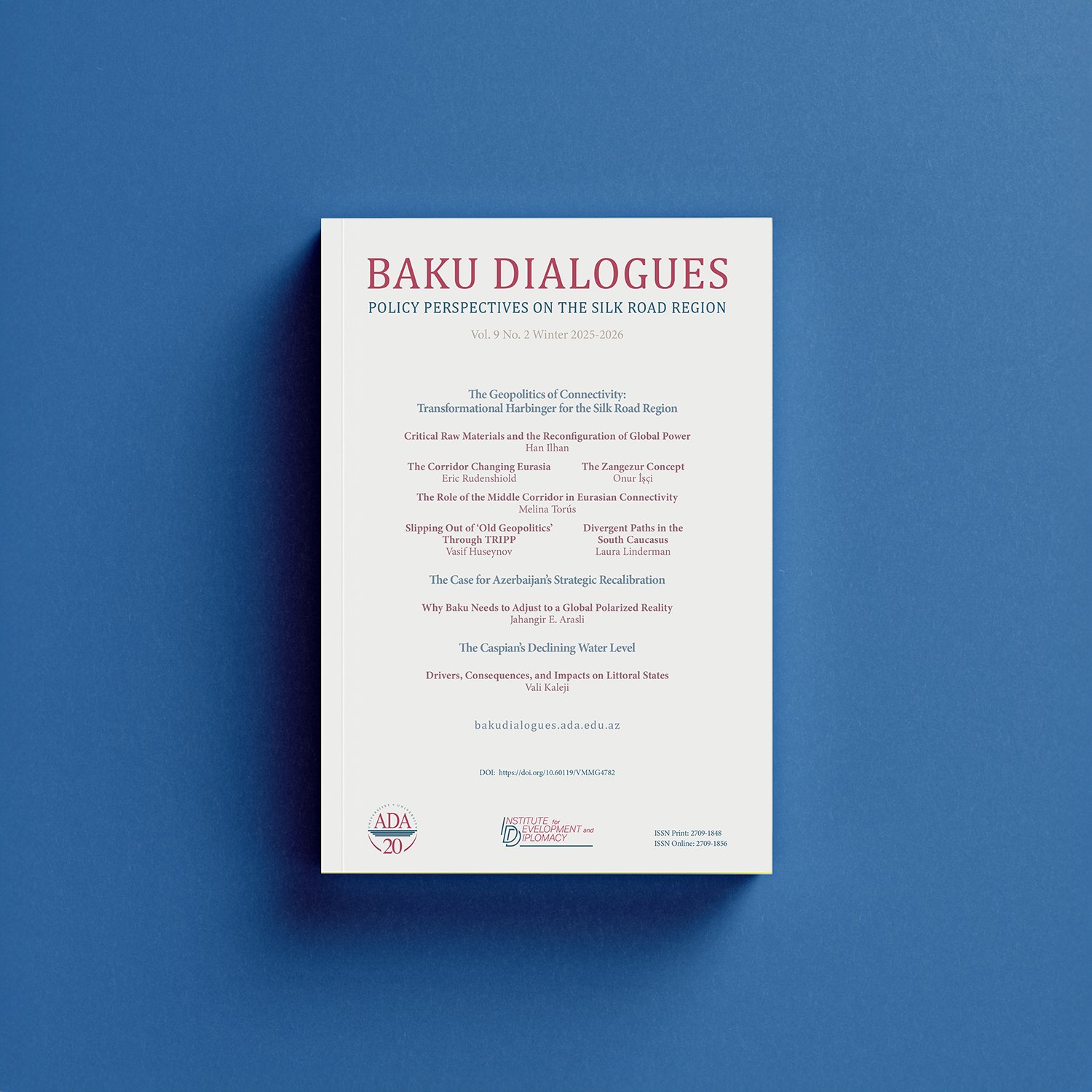
Why Baku Needs to Adjust to a Global Polarized Reality
In the 35 years since the restoration of its national independence, Azerbaijan performed a spectacular ascending trajectory. Having overcome early troubles, the country restored its full territorial integrity and sovereignty, accelerated its pace of development, and firmly entrenched itself as a “keystone state” that commands international respect and credibility.
All this was not the case at first. Armenia’s full‑scale military invasion of Azerbaijan that began in the late 1980s, and the subsequent occupation of a significant share of national territory, overshadowed the initial stages of Azerbaijan’s independence, projecting insecurity, hindering domestic development, and consuming efforts, treasure, and blood. Certainly, the liberation of the occupied territories emerged as the ultimate national goal and remained so for nearly three decades. Eventually, in 2020‑2023, Azerbaijan accomplished this mission through the application of all tools of national power (military, diplomatic, and economic).
However, the accomplishment of that principal mission does not mean that the state can afford to be complacent. The system of threats, risks, and challenges to national security evolves continuously and rapidly in all parts of its spectrum, ranging from geopolitics to technology.
The global system has entered into а profound and turbulent period of transformation. These changes include (but are not limited to) the relative decline of status quo powers and the rise of new assertive ones, shifts in international alignments and multipolarization, mounting strategic competition and hastening alliance‑building, durable conflicts and the erosion of respect for international law, and the growing impact of novel and potentially disruptive technologies. A fragmented constellation of competitive and issue‑based state groupings now supersedes the largely unipolar post‑Cold War global architecture. A stronger emphasis on hard power, transactionalism, the weaponization of the world economy and trade, the pursuit of control over resources and logistical routes, and the mounting factor of artificial intelligence are defining and driving geopolitics and international relations. These long‑term trends will shape security dynamics worldwide in the second half of this and, at a minimum, the entirety of the next decade.
As the existing global order reaches its inflection point, generating greater chaos and risk, Azerbaijan must adapt its strategic behavior to the emergent post‑”rules‑based liberal international order” era of strategic transactionalism and the return of the utility of force. Therefore, this Baku Dialogues article seeks to conceptualize and frame Azerbaijan’s strategic posture within the evolving global and regional security environment and to assess its potential future trajectories.
This Baku Dialogues article seeks to conceptualize and frame Azerbaijan’s strategic posture within the evolving global and regional security environment and to assess its potential future trajectories.
Multi‑Regional Nexus and the Effect of “Two Windows”
To understand Azerbaijan’s strategic posture, it is necessary to assess its regional positioning. Unlike many other states, this one uses a unique polygonal metric. Placed in the pivotal location of core Eurasia, Azerbaijan fits at once into several partially overlapping geopolitical, geoeconomic, and geocultural loci, as follows:
- Geopolitically: the South Caucasus and the Greater Caucasus; the Caspian Sea region (a.k.a. the Caspian‑Central Asian region) and Greater Central Asia; the Wider Black Sea region; and the Greater Middle East.
- Geoeconomically: the Silk Road Region.
- Geoculturally: the Turkic world and the Muslim world.
In addition, Azerbaijan fits the political construct of the Global South and the steadily fading into history, yet enduring, virtual realm of the post‑Soviet space.
All of the aforementioned loci may differ in nature and be disconnected geographically. However, their inherent dynamics influence Azerbaijan, directly or indirectly, through a set of shared security, political, economic, and cultural denominators.
Such a sensitive, multilayered disposition at the conjunction of several geopolitical and geocultural platforms objectively makes Azerbaijan an essential cross‑regional actor whilst simultaneously opening two “windows”—one of opportunity and one of vulnerability. Its pivotal location in core Eurasia, at the fulcrum of connectivity routes and projects, provides lucrative economic and developmental opportunities. At the same time, it presents ongoing challenges of various kinds and at different scales.
I highlight five major aspects in this regard.
First, at the current stage and at least in the midterm perspective, the security environment in the extended outer perimeter of Azerbaijan deteriorates due to the enduring confrontations of two major neighboring powers—Russia and Iran—with extra‑regional powers (Ukraine and the West in the former case, and Israel and the U.S. in the latter one). The resulting trends are the militarization of the contiguous regions and a “migration” of hostilities to very close proximity to Azerbaijan’s immediate edge, such as the Caspian Sea. Additionally, these conflicts are producing negative domestic impacts on the aforementioned neighbors, which, in turn, are making them both economically fragile and politically unstable.
Second, the resurgent trend of alliance‑building also contributes to militarization and polarization in the regions contiguous to Azerbaijan. Worth watching in this regard is the robust Moscow‑Tehran‑Pyongyang strategic triangle and the strengthening of strategic cooperation between Armenia, India, France, Greece, and some other states. These ad hoc constructs have not yet been formalized, although they have already been operationalized and made effective.
Most recently, two additional competing configurations have begun to form in the vast space consisting of the Middle East, North Africa, and the Horn of Africa: one comprising the United Arab Emirates and Israel (with additional actors), and the other anchored by Türkiye, Saudi Arabia, and Egypt. For Azerbaijan, which maintains close relations with all of the aforementioned states, this means the need to carefully calibrate a balanced political line.
Third, although the peace process between Baku and Yerevan is underway towards its definite point, opening a window for incremental reconciliation and promising economic perspectives for both states, Azerbaijan must stay vigilant and steady in order to prevent Armenia’s potential relapse into revisionism due to particularities of its domestic dynamic.
Fourth, the impact of radical ideologies derived from distorted and politicized interpretations of Islam remains a persistent challenge that is able to transcend geographic spans and national borders via the “domino effect” produced by information technologies. Therefore, it is essential for Baku to heighten its monitoring of the potential resurgence of offshoots of the mutated transnational terrorist‑extremist networks (the Islamic State and Al‑Qaeda) in Afghanistan, Central Asia, and Russia’s provinces in the North Caucasus.
Fifth, some state actors became excessively addicted to a projection of “weaponized narratives” to pursue their foreign policy objectives and project influence. An irresponsible application of cognitive manipulation techniques and hybrid warfare tools from abroad is upsetting domestic stability and societal accord.
All of the aforementioned risk‑and‑threat facets are present in conditions characterized by the absence of a clear, overarching security architecture in the regions surrounding Azerbaijan and by an emerging power vacuum in some parts of those areas.
Building Robust International Alignments
After regaining independence in 1991, Azerbaijan sought mutually reinforcing interactions with willing foreign allies and partners that promised strategic advantages in achieving its national goals and objectives, related foremost to the liberation of its occupied lands. At this stage, the mission of constructing partnerships remains relevant, given the evolving and challenging security dynamics described above.
Azerbaijan’s objectives related to the strategic recalibration of its international alignments should cover the following five functional areas: deterring (military and hybrid security threats, including those from assertive powers pushing back against the fading “rules‑based” status quo); counterbalancing (alternative politico‑military groupings); protecting (functionality of shared geoeconomic megaprojects); containing (proliferation of extremist ideologies and actors); and confronting (application of malicious cognitive narratives) in the country’s interior as well as both immediate and extended neighborhoods.
In this regard, the most promising avenue for advancement is maturing cooperation within the framework of the Organization of the Turkic States (OTS). Beyond other integration projects, this interstate organization starts steadily developing its embryonic politico‑military architecture. Its foundations essentially rest on the long‑existing Türkiye‑Azerbaijan strategic alignment that proved its effectiveness during the 2020 Second Karabakh War and received its boost with the advent of the 2021 Shusha Declaration of strategic cooperation between the two states. The Baku‑Ankara kernel strategic partnership is a model for wider defense and security collaboration within the OTS configuration, which is increasingly engaging four Central Asian states. The OTS’s October 2025 summit in Gabala opened the door to joint military exercises and to collective security measures among member states in the cyber domain. It appears that defense technological standardization and the tight cooperation of intelligence and security services have also been placed on the agenda.
It is premature to forecast the transformation of the OTS into a fully‑fledged defense alliance for several reasons. Enough to say that the organization encompasses the members of such antagonistic entities as NATO and the Collective Security Treaty Organization (CSTO) at the same time. Nonetheless, the nascent security coordination within the OTS already faces suspicion from other actors: foremost Russia and Iran, and to a lesser extent China. Such reactions should make the OTS member states’ integration actions more calibrated in speed and scope so as to avoid unnecessary security dilemmas that would affect regional security.
Beyond maturing cooperation within the OTS, another potential avenue for strategic assurance for Azerbaijan is its collaboration with Türkiye and Pakistan in a trilateral format. In addition to their security guarantees, Azerbaijan could benefit from both partners’ renowned expertise in specific defense domains (e.g., unmanned systems from Türkiye and missile systems from Pakistan). Ankara offers a full package of defense technology, knowledge, training, tactical solutions, and doctrinal interoperability. Furthermore, trilateral cooperation can facilitate the outspreading of Azerbaijan’s defense and security relations with countries within Türkiye’s and Pakistan’s (non‑Western) strategic ecosystems, such as Saudi Arabia, Qatar, Oman, Syria, some Western Balkan states, and some Global South states.
A further potential avenue of strategic assurance is NATO, with which Azerbaijan has maintained a sustained association since 1994, when the country joined its Partnership for Peace program. This measured and rational cooperation provides Azerbaijan with additional multipliers, including political and security dialogue, NATO‑grade defense education standards, interoperability procedures, and selective engagement in NATO‑led multinational missions. Baku is also open for reciprocal security cooperation with Western powers at the bilateral level, the latest evidence of which is the Charter of Strategic Cooperation signed with America in February 2026 during U.S. Vice President JD Vance’s visit to Baku.
Sharpening the Defense Edge
The superfluity of ongoing armed conflicts and wars worldwide illuminates rapid and fundamental changes in the character of warfare, its increasing multilayered complexity, innovation, and sophistication, and the general utility of force. Lessons learned from these compel Baku to uphold and continually refine its deterrent potential capabilities and instruments. To that end, Azerbaijan could leverage its foreign partnerships to develop more advanced defense capabilities, including, among other elements, a high‑profile pool of deep‑strike assets (e.g., missiles and unmanned aerial systems), multi‑spectral sensors, AI‑enabled command‑and‑control networks, efficient logistics, and a robust cyber‑defense shield.
Azerbaijan should also consider the possibility of raising limited but effective deployable expeditionary capabilities for potential participation in multinational stabilization missions (such as peace support and humanitarian operations) in regions related to advancing its national interests (in the spirit of its initial experience in Afghanistan and Iraq in the 2000s‑2010s).
Continuity in its current, well‑balanced defense procurement policy is an imperative. Intelligent diversification of weapons and technology acquisitions would help circumvent one‑sided dependencies on particular foreign suppliers. A further advancement of the already existing domestic defense technological‑industrial base is one of the cornerstone elements of national defense and security policy.
Last but not least is bolstering its national intelligence apparatus, an issue that is becoming increasingly relevant as a tool of heightened security awareness and assessment in an increasingly uncertain global environment.
Certainly, implementing all aforementioned endeavors requires political commitment, financial resources, administrative prioritization, and time. However, strengthening and enhancing national security is worth the burden.
Geo‑Logistics: Azerbaijan in the Context of the “Game of Corridors”
Control over global logistical itineraries, waterways, and nodes is emerging as a central issue in the unfolding strategic competition among power centers. Due to the circumstances of geography, Azerbaijan’s location precisely fits one of the critical spots of this competition. Several already existing, emerging, or projected vital transnational transportation and energy corridors originate from or pass through its territory and waters, constituting a web that includes:
- The Trans‑Caspian International Transit Route (TITR), also known as the “Middle Corridor,” a mega‑project that links Asia to Europe and embeds the Trump Road for Peace and Prosperity (TRIPP) into the region’s geostrategic architecture, which also includes the China‑led Belt and Road Initiative (BRI).
- The International North‑South Transportation Corridor (INSTC), a longitudinal venture that threads together Russia, Iran, India, and both the Central Asian and GCC states.
- The Southern Gas Corridor (SGC), which encompasses the Trans‑Anatolian (TANAP) and Trans‑Adriatic (TAP) pipelines, delivers Azerbaijani natural gas to Europe and enhances the energy security of the EU and its member states.
- The Trans‑Caspian Pipeline (TCP), a contemplated project related to the exploration and exploitation of Caspian offshore gas.
- The Baku‑Tbilisi‑Ceyhan oil pipeline (BTC), one of the first Caspian energy‑related enterprises, whose relevance grows again with the redirection of a share of the Kazakh oil export to its terminals.
- The Black Sea and Trans‑Caspian Green Electricity Corridors, a two‑part proposed joint Hungary‑Romania‑Georgia‑Azerbaijan‑Kazakhstan‑Uzbekistan undertaking to export electricity from renewable sources (solar, wind, and tidal) to the European continent.
- The Digital Silk Road (DSR), a planned communications project to connect several regions with cyber cables laid across the Caspian seabed.
In addition to its full engagement in the aforementioned strategic infrastructural endeavors, Azerbaijan could potentially associate itself, in one form or another, with the India‑Middle East‑Europe Economic Corridor (IMEC), which is correlated to the U.S.‑engineered Abraham Accords, and the U.S.‑led Pax Silica initiative on the development of secure and sustainable supply chains of critical minerals.
The heavy concentration of such strategic routes underscores Azerbaijan’s growing strategic value, which in turn could transform a fully engaged Azerbaijan into Eurasia’s “solar plexus.” Just a single glance at a map of Eurasia makes a clear impression of Russia and Iran together “cutting” the continent in two from the Indian Ocean to the Arctic shores. In these settings, Azerbaijan emerges as a “valve” that enables circumvention of that major chokepoint.
There are three relevant aspects stemming from the foregoing. First, significant economic stakes in the projects of trans‑regional magnitude compel Azerbaijan to be concerned and, if needed, to be practically involved in contributing to stability in its extended neighborhood. The key areas in this regard are Georgia (Azerbaijan’s western “gateway”), Central Asia, the Eastern Mediterranean, the Gulf, the Balkans, and the Russian North Caucasus.
Second, the vital interests of various extra‑regional actors (the U.S., the EU, China, India, Japan, South Korea, the GCC states, Israel, and others) in these projects increase Azerbaijan’s international prominence and incentives to cooperate with it, including in defense and security. Assurances from stakeholders reinforce the country’s strategic posture.
Third, Azerbaijan emerges not only as a security consumer but also as a security provider. A particular example is the country’s contribution to the EU’s energy security, which helped its member states overcome the initial 2022 shock of the war in Ukraine, establish a reliable supply chain, and diversify energy sources.
Taken together, Azerbaijan’s deep and multifaceted incorporation into the geoeconomic landscape of the Silk Road region confers strategic benefits on the country, strengthens its international capitalization, and objectively enhances its security amid existing and emerging challenges.
Azerbaijan as a Landlocked Maritime Nation
The Caspian Sea is a national treasure and a key strategic asset for Azerbaijan, whose history, culture, economy, and security are inherently related to this water basin. The greatest share of its national wealth proceeds from the exploitation of offshore and onshore energy resources. The infrastructural web of logistical and energy corridors, referred to in the previous section, stretches out across the Caspian waters and coast. The national capital, government institutions, most economic activities and industrial facilities, and over half of the population remain concentrated within a 10‑kilometer radius from the coastline.
All of the above make a prioritized focus on maritime security Azerbaijan’s strategic imperative. The lessons learned from the ongoing wars in Ukraine and the Middle East illustrate clearly that the maritime domain (due to its natural characteristics) is the most vulnerable to the potential hostile power projection, especially when released in a hybrid manner. After liberating the occupied parts of its national territory and formalizing the resulting peace treaty with Yerevan, Baku’s paramount task is to ensure and enhance security in the Caspian maritime domain.
After liberating the occupied parts of its national territory and formalizing the resulting peace treaty with Yerevan, Baku’s paramount task is to ensure and enhance security in the Caspian maritime domain.
Moreover, one of Baku’s top priorities should be establishing a sophisticated, technology‑enabled maritime domain awareness system covering surface, underwater, aerial, and coastal subdomains, based on a versatile network of early‑warning seabed sensors, radars, unmanned aerial systems, and uncrewed surface vehicles.
An equally important priority is the acquisition of surface naval platforms to provide effective protection (and defense) of offshore and onshore critical infrastructure related to geoeconomic projects, which has strategic significance for national interests revealed in the previous section.
Beyond the defense domain, Azerbaijan must focus on expanding its merchant fleet. The soaring significance of the Caspian Sea as the vital intersection of transit corridors necessitates the construction of more hulls (e.g., oil tankers, Ro‑Ro and dry cargo vessels, and ferries). Suffice it to remember that beyond the Caspian basin, Azerbaijan operates numerous vessels on commercial shipping lanes in the outer maritime theaters, including the Black and the Mediterranean Seas. These considerations underscore the necessity of developing a national shipbuilding industry and port infrastructure.
Strategic Synopsis
Serving as both a summary of the argument contained in this article and a look beyond it, what follows should be considered as a sort of synopsis to provide food for thought to policymakers and observers of Azerbaijan’s strategic posture:
- By the end of the first quarter of the twenty‑first century, with the full restoration of its territorial integrity and sovereignty—a paramount mission for three decades—Azerbaijan has solidified its national security posture.
- Meanwhile, a sensitive multi‑locus positioning of the country entails a system of present‑day intricate risks and threats that require continuous monitoring, forecasting and foresight, prevention, and, in some extreme cases, agile preemption.
- Above that, the nature of existing and emerging realities necessitates out‑of‑the‑box visionary thinking and a proactive approach rather than a reactive one.
- To address its challenges effectively, Azerbaijan must maintain an efficient, sophisticated defense and security system with matching capabilities and should accept the associated burden.
- Elaborating on its strategic posture, Azerbaijan should grasp that its increased significance on a Eurasian scale, international weight, and outreach of power have their natural limits. Therefore, international defense and security alignments with kin, friendly, or willing states emerge as an indispensable instrument in Azerbaijan’s national security toolbox.
- With that, international pooling should be designed to minimize impact on third parties; Azerbaijan must avoid its integration into a framework of strategic competition and “new great games” on either side and find a measured balance between national sovereignty and commitments stemming from external alignments.
In an ideal world, Azerbaijan’s recalibrated strategic posture should be codified in a new National Security Strategy (NSS) and related conceptual documents. The early procedures already materialized with the official endorsement of the National Security Concept (2007), the Military Doctrine (2010), and the Maritime Strategy (2013). Nowadays, it would make sense to adjust the national security calculus articulated in the aforementioned documents with evolving paradigms. It would also be appropriate, in line with the accepted international practice, to enhance the mentioned set with other issue‑focused documentation, for instance, a cybersecurity strategy or a countering terrorism, violent extremism, and radicalization strategy. Such a bundle of architectonic scripts would identify the nature and sources of existing and emerging security risks, threats, and challenges; define key national interests, priorities, goals, and objectives; and outline ways and instruments of national power applicable for their implementation.
Geography is destiny, shaping geopolitical opportunities and flexibility: Azerbaijan stands where it sits. In the emerging new era of uncertainty and fragility, Baku is obliged to keep pace with the global realities, exploring its unique path to maintain rational strategic autonomy and agency, an independent policy based on a primacy of national interests, a sufficient defense and security organization, a technological edge, and carefully balanced international alignments. These interrelated mechanisms should serve the ultimate goal of sustaining safer and more secure life, peace, and prosperity for present and future generations.
Geography is destiny, shaping geopolitical opportunities and flexibility: Azerbaijan stands where it sits.