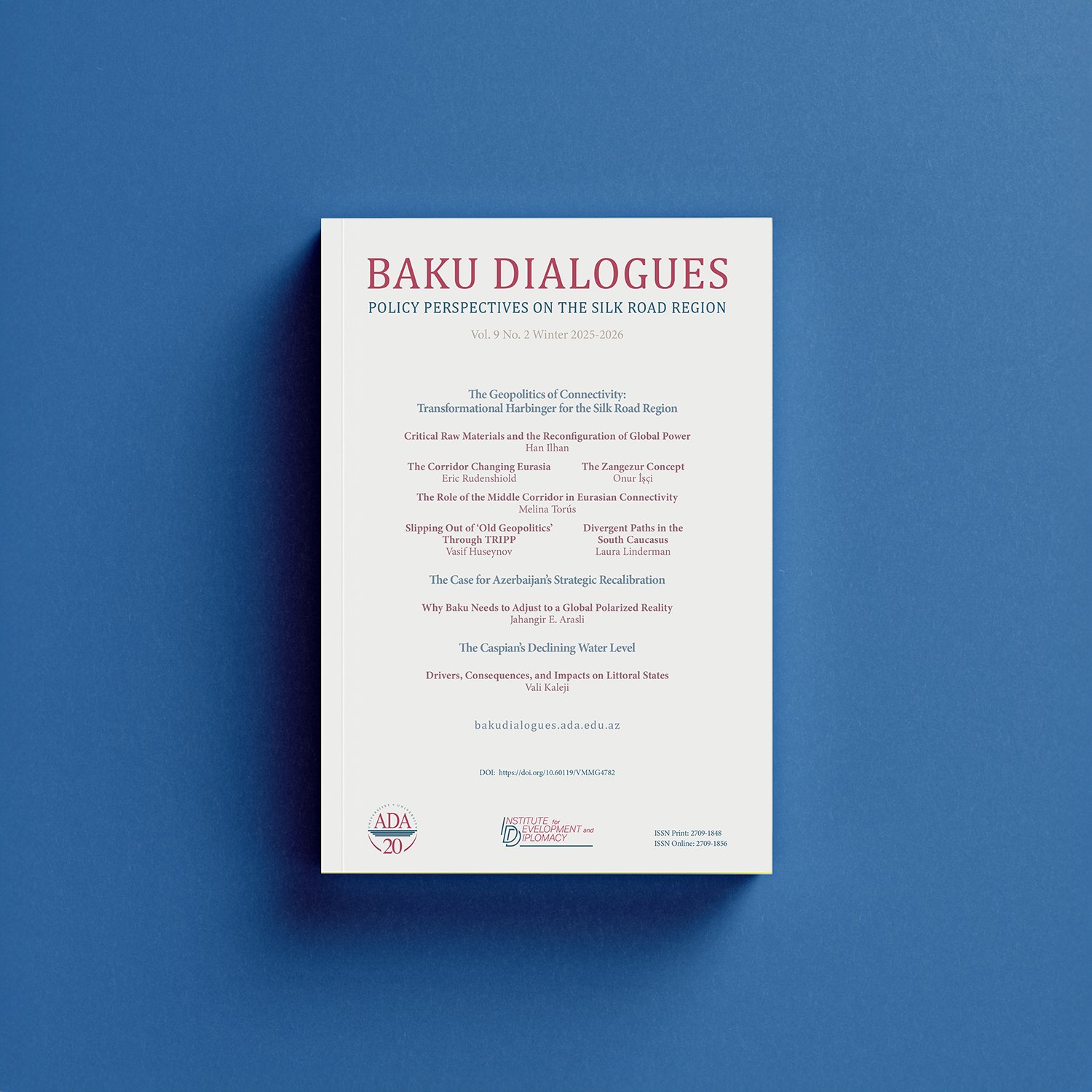
From Karabakh to Connectivity: The Zangezur Concept and the Remaking of Power in the South Caucasus

Onur İşçi

Onur İşçi is an Associate Professor in the Department of Political Science and International Relations at Boğaziçi University. He was previously an Associate Professor in the Department of Political Science and International Relations at Kadir Has University. The views expressed in this essay are his own.

In recent years, few words have acquired as much political weight in the South Caucasus as “corridor.” Once a largely technical term associated with infrastructure planning and trade routes, it has become shorthand for far broader debates about power, sovereignty, and regional order. Among these stands out the proposed Zangezur Corridor—with discourse now increasingly centered on the Trump Route for International Peace and Prosperity (TRIPP)—not because it is unprecedented, but because of what it represents in a rapidly transforming geopolitical environment.

At first glance, the idea appears straightforward: a transport link connecting mainland Azerbaijan to its Nakhchivan exclave through the southern Armenia region of Syunik (the Azerbaijani term for this region is Zangezur, hence the moniker), thereby creating a more direct land route between Azerbaijan and Türkiye (in contradistinction to two more circuitous ones, south via Iran and north via Georgia).

Framed narrowly, this is a question of logistics, transit fees, customs arrangements, and infrastructure security. Framed correctly, however, the Zangezur concept is something else entirely. It is a test case for how connectivity reshapes power relations in the post‑Soviet space—and for whether the South Caucasus can move from a history of frozen conflicts toward a model of managed competition and pragmatic cooperation.  The Zangezur concept is a test case for how connectivity reshapes power relations in the Silk Road region and for whether the South Caucasus can move toward a model of managed competition and pragmatic cooperation.

The Zangezur concept is a test case for how connectivity reshapes power relations in the Silk Road region and for whether the South Caucasus can move toward a model of managed competition and pragmatic cooperation

The renewed focus on the Zangezur Corridor is inseparable from the post‑2020 regional landscape. The Second Karabakh War did not merely alter borders or military balances; it disrupted longstanding assumptions about immobility in the South Caucasus. For decades, the region had been defined by closed borders, interrupted transport routes, and unresolved disputes treated as permanent fixtures rather than temporary conditions. The Second Karabakh War—and the diplomatic processes that followed—forced all regional actors to confront a new reality: connectivity was no longer optional, and isolation was no longer sustainable.

Yet it would be a mistake to view the Zangezur Corridor debate simply as a linear outcome of the end of the territorial conflict over Karabakh and the resulting Armenia‑Azerbaijan peace process. The corridor has gained prominence because it sits at the intersection of several overlapping trends. One is the growing centrality of geoeconomics in regional politics, where access, transit, and logistics increasingly matter as much as formal alliances. Another is the gradual redefinition of sovereignty in a world where states seek not absolute control, but strategic autonomy—the ability to make choices without excessive dependence on any single external power.

Seen through this lens, the Zangezur Corridor issue is less about shortening distances than about recalibrating relationships. For Azerbaijan, it promises to consolidate territorial connectivity while reinforcing its role as an indispensable regional hub linking the Caspian basin to Anatolia and beyond. For Türkiye, it offers a tangible extension of its long‑articulated vision of deeper engagement with the South Caucasus and Central Asia—one grounded not in ideology, but in infrastructure and interdependence. Together, these dynamics elevate the Türkiye‑Azerbaijan relationship from a close bilateral partnership into a regional structuring force.

The Zangezur Corridor issue is less about shortening distances than about recalibrating relationships.

This is precisely why the Zangezur Corridor concept provokes anxiety as well as interest. For Russia and Iran, it is not threatening because it redraws borders—it does not—but because it alters patterns of influence. Both states have long operated in a South Caucasus defined by bottlenecks, dependencies, and limited alternatives. A functioning east‑west and north‑south network that bypasses traditional chokepoints inevitably raises questions about leverage, control, and relevance. These concerns do not amount to opposition per se, but they do ensure that the corridor will remain politically sensitive and diplomatically contested.

What is often overlooked in public debates, however, is that the Zangezur Corridor need not be a zero‑sum proposition. The real risk lies not in the connectivity project itself, but in the way it is framed and pursued. If treated as a unilateral geopolitical victory, it could deepen mistrust and provoke countermeasures. If approached as part of a broader effort to optimize connectivity and reduce structural isolation in the South Caucasus, it could contribute—gradually and imperfectly—to a more stable order across the Silk Road region (the preferred term of this journal’s editors for what is traditionally described as core Eurasia, that is the states of the South Caucasus and Central Asia, extending into their respective neighborhoods).

This article argues that the significance of the Zangezur Corridor lies precisely in this tension. It is neither a panacea nor a provocation by default. Rather, it is a lens through which to understand how the South Caucasus is being reshaped by the interaction of infrastructure, strategic partnerships, and shifting power balances. The question is not simply whether the Zangezur Corridor will open, but, more importantly, how its opening—or prolonged ambiguity—will redefine the political economy of the region.

In the sections that follow, the Zangezur Corridor debate will be situated within the broader transformation of the South Caucasus after 2020, the evolution of the Azerbaijan‑Türkiye strategic axis, and the geoeconomic logic increasingly driving regional politics. By examining both opportunities and risks, the goal is to move beyond slogans and toward a more realistic assessment of what connectivity can—and cannot—deliver in a historically fragile region.

How We Got Here

The renewed debate over regional connectivity in the South Caucasus and, more broadly in the Silk Road region, cannot be understood without revisiting the political rupture resulting from the outcome of the Second Karabakh War. For nearly three decades, the region had operated under an assumption of permanence: borders were closed, transport routes severed, and unresolved conflicts treated as static realities rather than evolving problems. This stasis shaped not only diplomatic behavior but also economic planning, regional integration, and external engagement.

The results of the 2020 war shattered that equilibrium. While its immediate consequences were military and territorial, its longer‑term impact has been structural. The end of the territorial conflict over Karabakh disrupted a system built on blockage and inertia and replaced it with one characterized by movement, uncertainty, and renegotiation. In this sense, the post‑2020 period initially marked a transition away from a frozen‑conflict environment to a phase of managed instability—one in which new arrangements are possible, but far from guaranteed.

Connectivity emerged as a central theme precisely because it addressed the core dysfunctions of the old order. The South Caucasus had long been fragmented into disconnected sub‑regions, each tied asymmetrically to external patrons and constrained by limited access to alternative routes. The absence of a diversity of east‑west and north‑south transit corridors was not merely an economic inefficiency; it was a political condition that reinforced dependency and reduced strategic choice.

The Armenia‑Azerbaijan November 2020 ceasefire statement brokered by Russia introduced the possibility—though not the certainty—of reversing this logic. By reopening discussions on transport links and regional connections, it implicitly challenged the notion that isolation was a necessary or permanent feature of the South Caucasus. This shift did not resolve underlying disputes, but it altered the framework within which they were managed. Connectivity became a bargaining tool, a confidence‑building mechanism, and, for some actors, a source of leverage.

It is within this context that the Zangezur Corridor gained prominence. Rather than appearing as an externally imposed project, it emerged organically from the recognition that postwar arrangements would be incomplete without addressing the region’s physical and economic fragmentation. The corridor’s significance lies not only in its geography but in its timing. It reflects a moment when regional actors are reassessing long‑held assumptions about sovereignty, control, and interdependence.

Importantly, this reassessment has not been uniform. Armenia, Azerbaijan, and their neighbors approach connectivity from distinct historical experiences and strategic priorities. For some, reopening routes represents economic opportunity and normalization; for others, it raises concerns about security, autonomy, and political vulnerability. These diverging perspectives explain why progress has been uneven and why discussions around the Zangezur Corridor remain contested and emotionally charged.

External actors have further complicated the picture. Russia’s role as both security guarantor and regional stakeholder placed it in an ambivalent position. On the one hand, Moscow has an interest in stability and managed reopening of transport links; on the other, it is wary of arrangements that could dilute its traditional influence. Iran, meanwhile, views changes in regional transit patterns through the prism of border sensitivity and strategic access, particularly in relation to its northern frontier. Of course, the recent involvement of the United States, made public during an August 2025 White House summit involving the leaders of Armenia and Azerbaijan, which made TRIPP public, has added to the intricacies.

Despite these complexities, however, what distinguishes the post‑2020 environment from earlier periods is the erosion of veto power once exercised by inertia itself. In the past, doing nothing was often the default—and safest—option. Today, the costs of non‑connectivity are increasingly visible. Regional economies face missed opportunities, external actors recalibrate their engagement, and alternative routes begin to reshape broader Eurasian trade patterns without the South Caucasus at their center.

This does not mean that connectivity is inevitable or universally embraced. Rather, it suggests that the debate has shifted from whether to connect to how, on what terms, and under whose oversight. In this sense, the Zangezur Corridor concept has become a symbol of a broader transformation: a region tentatively moving away from isolation as a security strategy and toward interdependence as a risk to be managed rather than avoided.

Understanding how the South Caucasus arrived at this juncture is essential for assessing what lies ahead. The post‑Karabakh period has opened space for new initiatives, but it has also exposed unresolved tensions and asymmetries. Connectivity is now on the agenda not because conflicts have disappeared, but because their persistence has proven economically and politically unsustainable.

The challenge, therefore, is not to romanticize the post‑2020 shift, but to recognize its limits. The transition from blockage to connectivity is neither linear nor guaranteed. It requires political will, diplomatic coordination, and a careful balancing of interests—conditions that remain fragile. Zangezur sits at the heart of this experiment, embodying both the promise and the uncertainty of a not only a South Caucasus in transition, but that of the Silk Road region in its entirety.

The Ankara‑Baku Axis as a Regional Model

The growing prominence of the Zangezur Corridor cannot be separated from the evolution of Azerbaijan‑Türkiye relations over the past decade. What was once framed primarily through the language of shared identity and historical affinity has matured into a strategic partnership—formal alliance, even—with tangible regional consequences. This transformation matters not because it is exceptional, but because it offers a model of alignment that differs from both traditional alliances and transactional partnerships common in the post‑Soviet space.

The growing prominence of the Zangezur Corridor cannot be separated from the evolution of Azerbaijan‑Türkiye relations over the past decade.

At its core, the Azerbaijan‑Türkiye axis is built on functional coordination rather than ideological conformity. Energy cooperation, defense collaboration, transportation planning, and diplomatic synchronization have developed in parallel, reinforcing one another without being subsumed under a single institutional framework. This flexibility has allowed both sides to adapt to changing regional conditions while avoiding rigid commitments that could limit strategic maneuverability.

Energy was the first domain in which this approach became visible. Pipeline projects linking the Caspian to European markets did more than diversify supply routes; they embedded Azerbaijan and Türkiye within a shared geoeconomic logic. Over time, this logic expanded beyond hydrocarbons to encompass broader questions of connectivity and regional integration. Infrastructure ceased to be merely a commercial endeavor and became a platform for political coordination.

Defense cooperation further accelerated this shift. Joint exercises, training programs, and technology transfers created habits of coordination that extended beyond bilateral concerns. While often interpreted externally as power projection, these initiatives were equally about interoperability and signaling predictability in a volatile region. The result was not the formation of a bloc, but the emergence of a reliable strategic partnership capable of acting decisively when circumstances required it.

The post‑2020 environment amplified the significance of this strategic axis. In the aftermath of the Second Karabakh War, Azerbaijan and Türkiye demonstrated a capacity to align diplomatic messaging, manage escalation risks, and articulate shared priorities without overreliance on external mediation. This did not eliminate the role of other actors, but it reduced uncertainty regarding Ankara and Baku’s respective positions. In a region accustomed to ambiguity and mixed signals, this clarity itself became a form of influence.

The Zangezur Corridor fits naturally within this framework. For Azerbaijan, the project promises to consolidate territorial connectivity and reinforce sovereignty through integration rather than isolation. For Türkiye, it represents the materialization of a long‑standing aspiration to deepen engagement with the Silk Road region through practical mechanisms. Crucially, these objectives converge without requiring either side to subordinate its broader foreign policy priorities.

This convergence has implications beyond bilateral relations. The Azerbaijan‑Türkiye axis introduces a different logic into the post‑Soviet political landscape—one that emphasizes strategic autonomy over dependency. Rather than positioning themselves exclusively within the orbit of a single great power, both states have sought to diversify partnerships while maintaining coherence in their regional agenda. This approach resonates with other countries belonging to the Silk Road region that are navigating similar dilemmas, even if they lack comparable resources or geopolitical leverage.

It is precisely this aspect that distinguishes the axis from traditional alliances. The partnership does not define itself against a specific adversary, nor does it seek to export a particular political model. Instead, it operates through alignment on concrete interests: secure borders, open routes, and predictable engagement. In this sense, it reflects a broader shift toward pragmatic regionalism—a recognition that stability is more likely to emerge from managed interdependence than from rigid blocs.

Critics often interpret the Azerbaijan‑Türkiye relationship as inherently destabilizing, arguing that it upsets established balances and marginalizes other actors. Such assessments overlook the extent to which the previous equilibrium was sustained by stagnation rather than stability. The axis has not introduced competition into the South Caucasus; it has made existing competition more visible and, in some cases, more manageable.

None of this suggests that the model is universally applicable or free of risks. Strategic alignment requires sustained political commitment, mutual trust, and an ability to absorb external pressure. Miscalculations—particularly those driven by domestic politics or regional overconfidence—could undermine the very autonomy the partnership seeks to protect. Yet these vulnerabilities do not negate the broader significance of the model; they underscore the importance of restraint and coordination.

In the conceptual context of Zangezur, the Azerbaijan‑Türkiye axis serves as both an enabler and a stabilizer. It provides the political momentum necessary to keep connectivity on the agenda while offering a framework through which competing interests can be managed rather than escalated. Whether this balance can be maintained will depend not only on Ankara and Baku, but on the willingness of other regional actors to engage with connectivity as a shared challenge rather than a zero‑sum contest. This again points to the role that TRIPP can or can’t play.

Geoeconomic Logic

To understand why the Zangezur Corridor has assumed such outsized importance, it is necessary to move beyond traditional geopolitical readings and focus instead on geoeconomics—the growing interplay between economic connectivity and strategic influence. In the contemporary international system, power is increasingly exercised not through territorial expansion or formal alliances, but through control over flows of goods, energy, capital, and access.

From this perspective, Zangezur is not simply a regional infrastructure project; it is part of a broader reconfiguration of Eurasian connectivity. Over the past decade, global trade routes have become more fragmented, more politicized, and more vulnerable to disruption. Sanctions regimes, supply‑chain shocks, and geopolitical rivalries have heightened the value of alternative corridors that reduce dependence on single routes or chokepoints. The South Caucasus, long peripheral to these dynamics, is now being drawn into them (as is Central Asia).

The Zangezur Corridor’s geoeconomic appeal lies first in its ability to link existing networks rather than create entirely new ones. Azerbaijan already occupies a strategic position between the Caspian basin and the Black Sea‑Mediterranean space. Türkiye, in turn, serves as a gateway between Europe, the Middle East, and Central Asia. Zangezur would not invent connectivity where none exists; it would consolidate and streamline connections that are currently fragmented, indirect, or already operate at capacity.

This distinction matters. Successful corridors do not operate in isolation. They gain relevance when they reduce costs, shorten distances, and integrate seamlessly into broader trade ecosystems. By connecting mainland Azerbaijan to Nakhchivan and onward to Türkiye, Zangezur would enhance the efficiency of the Middle Corridor, reinforcing its viability as an alternative, sanctions‑free east‑west route across Eurasia. In doing so, it would also elevate the South Caucasus—and, indeed, the Silk Road region in its entirety—from a transit periphery to a connective node.

For Azerbaijan, this shift carries long‑term implications. The country’s role as an energy exporter has already positioned it as a critical player in regional markets. Connectivity infrastructure expands this role beyond hydrocarbons, enabling Azerbaijan to leverage its unique geographical position and the resulting advantages it holds in facilitating logistics, transit services, and multimodal transport as sources of economic and political capital. Over time, this diversification reduces vulnerability to price fluctuations and external pressure, strengthening strategic autonomy.

Türkiye’s calculus is complementary but distinct. Zangezur offers a concrete mechanism through which Ankara’s engagement with Central Asia can move from aspiration to implementation. For decades, Türkiye’s outreach to the Turkic world has been constrained by geography and limited physical access. The corridor does not eliminate these constraints entirely, but it mitigates them by embedding Türkiye more firmly within transcontinental trade flows. Connectivity, in this sense, becomes a tool of foreign policy—not through dominance, but through relevance.

The geoeconomic logic of Zangezur also explains why the corridor generates concern among neighboring powers. Russia’s traditional influence in Eurasian transit has rested on inherited infrastructure and regulatory control. Iran, similarly, has viewed north‑south routes as central to its regional positioning. The emergence of alternative pathways (in addition to the existing one via Georgia) does not negate these roles, but it introduces competition into a domain long shaped by limited choice. In a system where leverage often derives from exclusivity, diversification is inherently disruptive.

Yet disruption should not be conflated with destabilization. From a geoeconomic standpoint, multiple corridors can coexist, each serving different markets and strategic priorities. The challenge lies in ensuring that competition remains commercial rather than coercive. Zangezur’s viability will depend not only on physical construction, but on governance arrangements that emphasize predictability, transparency, and mutual benefit.

This is where the corridor’s political dimension intersects with its economic rationale. Geoeconomic projects succeed when they are insulated—at least partially—from day‑to‑day political volatility. Excessive securitization risks undermining precisely the efficiency gains that make corridors attractive in the first place. If Zangezur becomes a permanent object of geopolitical signaling, its economic potential will remain constrained.

At the same time, it would be naïve to suggest that connectivity can ever be fully depoliticized in the South Caucasus. Borders, sovereignty, and historical grievances remain deeply embedded in regional consciousness. The task, therefore, is not to strip Zangezur of political meaning, but to manage that meaning in ways that support long‑term integration rather than episodic confrontation.

Ultimately, the geoeconomic promise of Zangezur lies in its capacity to normalize movement in a region long defined by blockage. By lowering the political and logistical costs of exchange, the corridor has the potential to reshape incentives—encouraging cooperation not because it is idealistic, but because it is materially advantageous.

This is what TRIPP is attempting to do, for its strategic logic consists of “effectively combining conflict resolution, peacemaking, transport and energy connectivity, commercial opportunities, and respect for everyone’s sovereignty,” as this journal’s co‑editor has written recently. Whether this potential is realized will depend on choices made not only in Ankara and Baku, but across the wider region.

Managing, Not Ignoring, the Other Powers

Any serious discussion of the Zangezur Corridor must address the positions of Russia and Iran—not as peripheral spoilers, but as enduring regional actors whose interests and perceptions will shape outcomes. Ignoring these dynamics risks turning connectivity from a stabilizing force into a source of prolonged tension. At the same time, overstating their opposition obscures the more nuanced reality in which adaptation, rather than outright resistance, increasingly defines their approach.

Russia’s perspective on the Zangezur concept is shaped by its historical role as the principal security arbiter in the South Caucasus. For decades, Moscow benefited from a regional order characterized by limited mobility and constrained alternatives. Transport bottlenecks and unresolved conflicts reinforced its position as an indispensable intermediary. Connectivity, by contrast, introduces optionality—an attribute that naturally complicates influence built on exclusivity.

Yet Russia’s interests are not uniformly threatened by the corridor—even in its TRIPP incantation. Stability along its southern periphery remains a priority, particularly at a time when Moscow faces heightened pressures elsewhere. From this standpoint, controlled reopening of transport routes can serve as a mechanism for risk management rather than disruption. The challenge for Russia lies in balancing this interest in stability with concerns about losing regulatory and political leverage over emerging transit networks.

This ambivalence explains Moscow’s preference for frameworks that emphasize oversight and guarantees. Rather than opposing connectivity outright, Russia has sought to shape its modalities—favoring arrangements that preserve a role for external monitoring or coordination.

Such an approach reflects adaptation to new realities rather than denial of them. It also underscores a broader trend: influence in the South Caucasus is no longer exercised solely through presence, but through participation in evolving regional processes. For Moscow, participation in shaping emerging connectivity frameworks may prove more sustainable than attempting to preserve inherited arrangements indefinitely.

The history of Russian‑Turkish relations over the past century demonstrates how economic ties, from smokestacks to pipelines, have persistently tempered geopolitical rivalries, allowing both states to pursue development and strategic autonomy amid shared frustrations with Western dominance. Despite outright hostilities in the 1940s and competition in the South Caucasus during the 1990s, Moscow and Ankara repeatedly harnessed statist cooperation—from interwar textile factories to Cold War steelworks and post‑Soviet energy deals—to bypass international markets and offset dependencies. This pattern of managed interdependence underscores that Russia’s ambivalence toward Zangezur need not be oppositional, but can evolve into adaptive participation in regional connectivity frameworks. Here—to emphasize—the mediative role of Türkiye toward Russia should not be downplayed, especially in the context of TRIPP.

Iran’s concerns are different in origin but no less significant. Tehran views changes in regional connectivity through a lens of border sensitivity and strategic access. The southern Armenian region of Syunik occupies a unique place in Iran’s regional calculus, serving as a vital link to the north and a buffer against isolation. Any initiative perceived as altering this balance inevitably triggers apprehension.

At the same time, Iran’s reaction to Zangezur has often been interpreted in overly alarmist terms. The corridor does not sever Iran’s access to the region, nor does it preclude Tehran from pursuing its own connectivity initiatives. What it does is introduce competition into a space where routes and options were previously limited. For a state accustomed to navigating constraints through geography, this diversification requires adjustment.

Crucially, neither Russia nor Iran operates in a vacuum. Both face incentives to recalibrate rather than obstruct. Russia’s broader Eurasian ambitions increasingly depend on adaptable networks rather than rigid hierarchies. Iran, grappling with economic pressures and sanctions, has a material interest in regional trade and transit opportunities—even if these emerge alongside competing corridors.

The risk arises when Zangezur is framed as a geopolitical fait accompli rather than a negotiated process. Perceptions of exclusion or marginalization can harden positions and provoke countermeasures, even when underlying interests might otherwise converge. Managing these perceptions is therefore as important as managing infrastructure itself.

This is where diplomatic coordination becomes indispensable. Connectivity projects succeed not simply through construction, but through sustained dialogue that addresses security concerns, legal ambiguities, and symbolic sensitivities. Transparency, incrementalism, and inclusivity are not idealistic add‑ons; they are practical tools for reducing friction in a contested environment. 

Transparency, incrementalism, and inclusivity are not idealistic add‑ons; they are practical tools for reducing friction in a contested environment.

Ultimately, Russia and Iran are not external obstacles to be bypassed, but structural features of the South Caucasus landscape. Their influence may be evolving, but it is not disappearing. Like Türkiye (and unlike, say, the United States and, of course, the European Union), they are geographic neighbors—an unalterable fact. The question is whether that influence will be exercised in ways that accommodate a more connected region, or whether it will resist change through destabilizing means.

Zangezur’s future will hinge on this distinction. A corridor embedded within a broader framework of engagement has the potential to normalize competition and reduce uncertainty. A corridor pursued without regard for regional sensibilities risks becoming a permanent fault line. The difference lies not in geography, but in governance.

Risks, Misreadings, and False Expectations

The growing attention surrounding the Zangezur Corridor has generated not only optimism, but also a set of assumptions that risk obscuring its actual significance. Connectivity projects often invite inflated expectations, particularly in regions where isolation has long been equated with security. Zangezur, especially its TRIPP variant, is no exception. Treating it as a transformative solution rather than a conditional opportunity could ultimately undermine the very stability it is expected to promote.

One common misreading lies in the belief that opening a corridor will, by itself, resolve deeper political disputes. Infrastructure can facilitate interaction, but it cannot substitute for trust or reconciliation. Without parallel diplomatic engagement, connectivity risks becoming transactional rather than integrative—useful for moving goods, but insufficient for easing political tensions. In the South Caucasus, where historical grievances remain deeply entrenched, this distinction is critical. Hence the importance of signing an Armenia‑Azerbaijan peace treaty in the wake of the Armenian parliamentary election scheduled to take place in June 2026, followed by an Armenia‑Türkiye one.

A second risk emerges from the securitization of connectivity. When transport routes are framed primarily as instruments of strategic competition, their economic logic is weakened. Excessive emphasis on control, monitoring, or symbolic dominance can raise costs and discourage participation. Over time, this undermines the corridor’s commercial viability and reinforces skepticism among stakeholders who view connectivity as a zero‑sum game.

Domestic political pressures further complicate the picture. In highly polarized environments, infrastructure projects are easily absorbed into nationalist narratives, where compromise is portrayed as concession and flexibility as weakness. Such framing may generate short‑term political gains, but it constrains long‑term policy options. Once connectivity becomes a test of political resolve rather than a tool of mutual benefit, pragmatic adjustment becomes politically costly.

There is also the risk of strategic impatience. Expectations that Zangezur will rapidly alter regional trade patterns or geopolitical alignments underestimate the gradual nature of geoeconomic change. Corridors do not produce influence overnight. Their impact accumulates through consistent use, regulatory harmonization, and trust built over time. Pressing for immediate results may lead to overextension or miscalculation.

External misperceptions add another layer of complexity. Observers outside the region often interpret Zangezur through familiar templates—great power rivalry, bloc formation, or proxy competition. This is especially the case with TRIPP. While these frameworks offer analytical shortcuts, they obscure local agency and the region’s internal dynamics. The South Caucasus is not merely a stage on which external actors perform; it is a space where regional states actively shape outcomes, sometimes in ways that defy external expectations.

Perhaps the most significant risk, however, lies in conflating connectivity with inevitability. The assumption that economic logic will automatically override political resistance ignores the persistence of security dilemmas and institutional fragility. Connectivity is a choice, not a law of nature. It requires sustained commitment, careful sequencing, and the willingness to absorb setbacks without abandoning the broader objective.

Recognizing these risks does not diminish the importance of Zangezur; it clarifies the conditions under which it can contribute positively to regional transformation. The corridor’s potential will be realized not through maximalist claims or symbolic gestures, but through incremental progress grounded in realistic assessments of capacity and constraint.

In this sense, Zangezur functions as a mirror reflecting broader regional tendencies. It exposes the tension between ambition and restraint, between geopolitical symbolism and geoeconomic pragmatism. How these tensions are managed will determine whether connectivity becomes a stabilizing force or another layer of contestation.

The challenge, therefore, is not to dampen expectations, but to recalibrate them. A corridor that is understood as part of a long‑term process—rather than a decisive breakthrough—stands a far greater chance of delivering durable benefits. Managing disappointment may prove just as important as managing opportunity.

The manner in which TRIPP was rolled out and continues to be presented is perhaps a surprising testament to the Trump Administration’s willingness to navigate ambiguity and complexity in this part of the world. Whether it ultimately passes the viability test remains, as of this writing, an open question. Still, it seems to be the most realistic way forward for the actualization of the Zangezur Corridor concept.

Managed Transformation

The debate surrounding the Zangezur Corridor offers a rare window into how the South Caucasus is changing—and how it and the rest of the Silk Road region might yet change further. More than a transport project, the corridor has become a focal point for competing interpretations of sovereignty, connectivity, and regional order. Its significance lies not in the certainty of its outcome, but in what it reveals about a region cautiously moving beyond the logic of permanent blockage.

What distinguishes the current moment from earlier periods is not the absence of conflict, but the erosion of isolation as a default strategy. The post‑2020 landscape has exposed the economic and political costs of immobility, prompting regional actors to reconsider long‑standing assumptions. Connectivity has entered the regional vocabulary not as an idealistic aspiration, but as a pragmatic response to accumulated constraints.

Within this context, the Azerbaijan‑Türkiye axis has emerged as a key driver of change. By translating political alignment into concrete mechanisms of cooperation, Ankara and Baku have demonstrated how strategic partnerships can shape regional dynamics without resorting to rigid alliances or exclusionary frameworks. This approach does not eliminate competition, but it renders it more structured and, potentially, more manageable.

At the same time, the Zangezur debate underscores the limits of unilateral action. Russia and Iran remain integral to the regional environment, not as immutable gatekeepers, but as actors whose adaptation will influence the corridor’s viability. Managing their concerns through dialogue and transparency is not a concession; it is a prerequisite for sustainable connectivity. In a region where misperception often escalates into confrontation, governance matters as much as geography.

The future of the Zangezur concept, with TRIPP now situated in a pole position, will therefore depend less on technical feasibility than on political calibration. Excessive securitization, inflated expectations, or symbolic maximalism risk transforming connectivity into a new source of friction. By contrast, incremental progress grounded in geoeconomic logic offers a path toward normalization—even if that path remains uneven and reversible.

Ultimately, the corridor’s most enduring impact may be conceptual rather than physical. Zangezur has conceptually reframed how regional actors think about access, autonomy, and interdependence. TRIPP, in particular, has shifted debates from questions of whether borders should remain closed to how openness can be managed without sacrificing security and sovereignty. This shift, however tentative, marks a departure from the zero‑sum thinking that has long constrained the South Caucasus. 

The debate has shifted from whether borders should remain closed to how openness can be managed without sacrificing security and sovereignty, marking a departure from the zero‑sum thinking that has long constrained the South Caucasus.

The region’s transformation will not be decided by maps alone. It will be shaped by choices—by the willingness to balance ambition with restraint, connectivity with diplomacy, and opportunity with responsibility. If approached in this spirit, Zangezur may come to represent not a rupture with the past, but a gradual reordering of regional relations—one defined less by isolation and more by managed engagement and, indeed, strategic transactionalism.