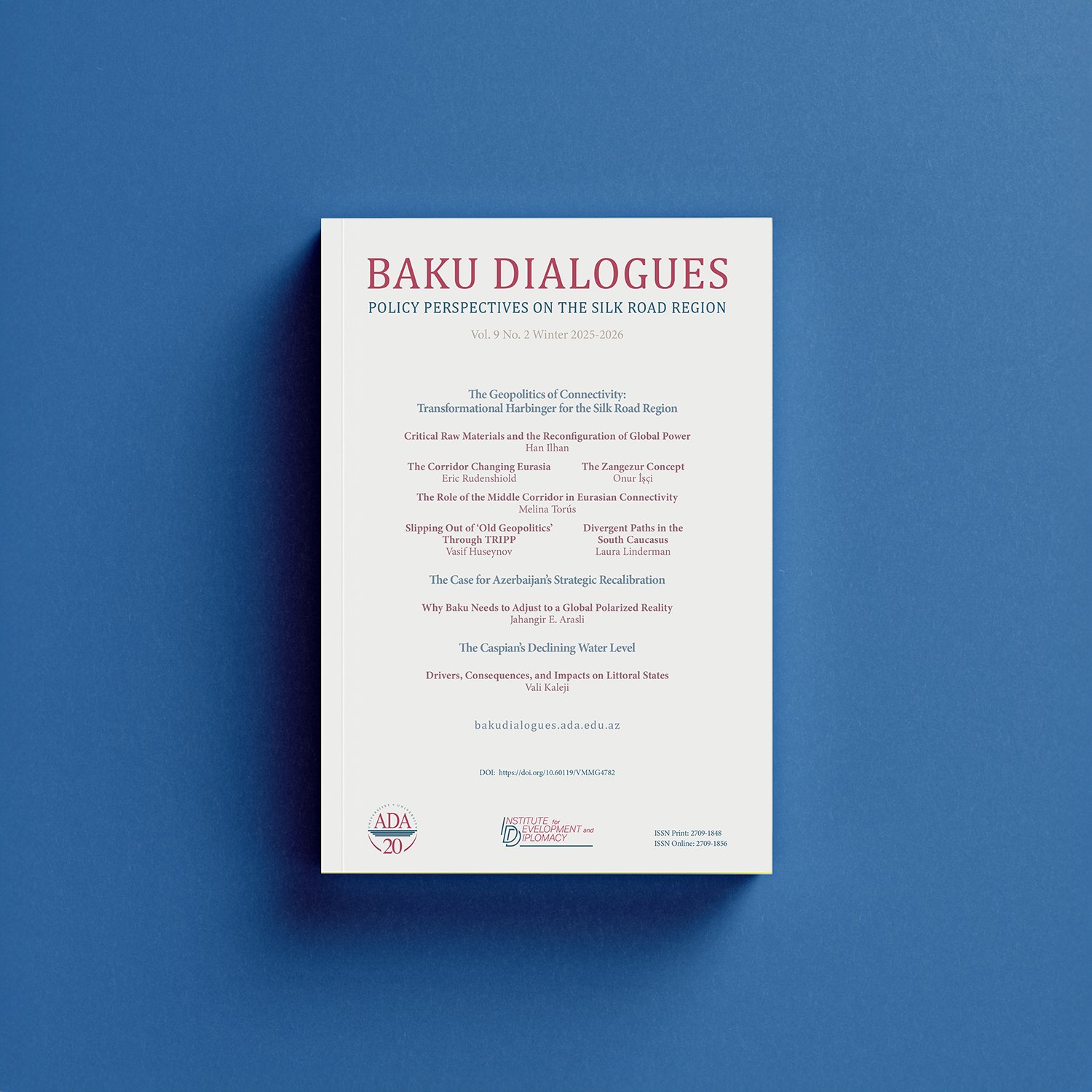
The Corridor Changing Eurasia: Connectivity, Sovereignty, and the Strategic Awakening of the Trans-Caspian Region
Since (re‑)gaining independence from the Soviet Union, the countries of Central Asia and the South Caucasus have been perceived by and large as flyover states of marginal interest. They were framed in geopolitical dialogue as peripheries or regions whose importance largely derived from adjacency rather than agency—from whom they bordered rather than what roles they could play. Especially in Western policy discourse, they were generally described as buffers or backyards, almost never as strategic actors in their own right. That framing is grossly outdated.
Over the past four years or so, what has been unfolding in Central Asia and the South Caucasus is not simply a shift in trade routing or a reaction to Russia’s war in Ukraine. Instead, it is a deep structural reordering of Eurasia’s political economy that is in parts driven by generational change, unfettered economic ambition, and recalibrations of sovereignty.
At the center of this transformation is the Middle Corridor, stretching from Central Asia across the Caspian and through the South Caucasus to Türkiye and Europe. Once a peripheral notion, it is now central to the entire region’s growth. No longer aspirational, the Middle Corridor has become a strategic instrument that binds roads, rails, ports, and policy into a single, multimodal system—one that extends beyond transportation to questions of power, choice, and sovereignty. The resulting whole is proving greater than the sum of its parts.
The catalyst for this shift was crisis. When Russia invaded Ukraine for the second time in 2022, the resulting international sanctions regime effectively closed Central Asia’s licit access to the northern transport corridor that transits Russian territory. The resulting disruption derailed most of the region’s trade and exposed long‑tolerated structural vulnerabilities and dependence on Soviet‑era infrastructure still zealously controlled by Moscow.
The shock and resulting transport vacuum forced Central Asian leaders to do three things. One, to make tectonic decisions that reoriented commercial and geopolitical linkages; two, to engage more pliable diplomatic postures; and three, to accelerate alternatives that had previously advanced only incrementally.
The Rebirth of Eurasian Connectivity
Russia’s February 2022 invasion of Ukraine marked a watershed moment not only for European security, but also for Eurasian connectivity. Northern routes that had long underpinned east‑west trade suddenly became liabilities. Western sanctions against Russia transformed the region’s transit infrastructure into instruments of economic coercion, and transit dependence shifted from a technical inconvenience into a strategic risk.
For Central Asia, the implications were immediate and profound. Landlocked states whose export routes flowed predominantly north confronted mounting costs and uncertainty as the promise of primary and secondary sanctions threatened the region’s fragile economies precisely at the moment when they had begun to recover from COVID‑19 shutdowns. The vulnerability exposed by Russia’s war revealed a deeper, structural truth about sovereignty in a globalized economy: sovereignty without connectivity is fragile and connectivity without choice is not sovereignty at all.
Sovereignty without connectivity is fragile and connectivity without choice is not sovereignty at all.
It was within this context that the Middle Corridor emerged as both remedy and declaration. Stretching from China through Central Asia, across the Caspian Sea, through Azerbaijan and Georgia, and onward to Europe via Türkiye, the corridor offered something unprecedented in the post‑Soviet space: a viable, scalable east‑west route that bypassed Russian territory while remaining commercially rational and politically inclusive. Unlike earlier alternatives, it offered unfettered access to global markets while not requiring wholesale realignment or ideological conformity. The Middle Corridor offered attractive optionality.
Importantly, regional leaders were careful not to frame the Middle Corridor as an anti‑Russian or anti‑Chinese project. The language that emerged emphasized diversification rather than decoupling. The objective was not to sever ties with major neighbors, but to end the condition of having no alternatives. This distinction matters.
By building redundancy into trade, energy, and increasingly data flows, however, the Trans‑Caspian regional states are reducing the capacity of any single external power to exercise veto influence over their economic futures. Infrastructure, in this sense, has become a quiet but powerful instrument of sovereignty for the South Caucasus and Central Asia. As a result, the Middle Corridor countries constitute an emerging geoeconomic bloc—a strategic set of economic decisions embedded in infrastructure.
The institutional expression of this shift has been equally significant. For much of the past decade, the so‑called “C5” format (representing the five Central Asian states acting collectively) functioned primarily as a consultative framework, often convened in the presence of external partners. While symbolically important, it remained limited in scope and ambition. Recent developments, however, indicate an evolution from ceremony to substance as the C5 is increasingly being used to coordinate policy positions, align infrastructure priorities, and articulate shared regional interests.
This development has been further reinforced by the emergence of a “C6” dynamic that reflects Azerbaijan’s growing integration into Central Asian diplomatic, economic, and connectivity frameworks and has effectively extended the region’s strategic perimeter westward across the Caspian. As a now de jure C6 participant, Azerbaijan has laid down markers to solidify trans‑regional connectivity and cooperation, linking Central Asia more directly to the South Caucasus, Türkiye, and European markets.
In both the C5 and C6 configurations, regional states are moving beyond performative diplomacy toward practical coordination. Deals, summits, and infrastructure agreements are increasingly designed to reorient trade flows, elevate regional autonomy, and institutionalize cooperation rather than merely signal it. The Middle Corridor serves as both the catalyst and the connective tissue for this shift, binding together geography, policy, economics, and strategy.
Taken together, these developments suggest that Central Asia and the South Caucasus are no longer passive recipients of external designs. Through the evolution of the C5 and expanded C6 framework, they are constructing a trans‑regional architecture that reflects their own priorities of partnership, alignment, and growing agency.
Decline and Rise
The growing assertiveness of the region’s capitals has been built upon strength in numbers and unified actions. In their collective response to Russia’s war in Ukraine, for instance, the five Central Asian states along with Azerbaijan and Georgia moved rapidly to develop alternative cargo routing, implement infrastructure improvements, and adopt new cooperation mechanisms to accelerate freight transit that did not rely on Russia. The resulting Middle Corridor connectivity also played a triggering role in precipitating the embrace of a corollary logic in Armenia and Azerbaijan that welcomed peace and prosperity over protracted and frozen conflict, offering the same access and options.
The growing logistical cooperation and adjustments that began four years ago have generated a strategic reorientation away from Russian hegemony. Central Asia and the South Caucasus are bridging the Caspian Sea to globally reemerge as increasingly unified energy and transport hub at the very center of Eurasia. Capitalizing on their geographic position, regional capitals are turning the tables on Moscow which itself long sought to dictate terms by controlling transit and, by extension, economic leverage across the vast steppe.
Though Russia’s authority in Central Asia and the South Caucasus has not collapsed, its traditional levers—security guarantees, transit control, and energy dominance—have eroded simultaneously, producing a cumulative loss of influence. In a regional perspective shift, Trans‑Caspian countries see less utility in defining themselves as Russia’s back yard.
In the context of Eurasian geopolitics, this decline of Russia’s traditional influence is perhaps the most consequential shift of the last decade. Moscow’s default and legacy capacity to serve as the region’s security guarantor and economic gatekeeper has been strained by the war in Ukraine, the weight of international sanctions, and the emergence of credible alternatives. In turn, this has accelerated a rebalancing of strategic relations across Central Asia and the South Caucasus, which, reciprocally, further reduces Moscow’s sway.
While Russia’s market dominance across the region was surpassed by China’s economic expansionism in the 2010s, security credibility has since eroded as Russian military capacity is largely redeployed into Ukraine. Transit dominance has been challenged by westward routes that are increasingly viable and free of sanctions. Energy leverage, while still significant, now competes with diversification strategies and alternative export pathways.
What has filled this space is not a new hegemon, but a more pluralistic and strategic environment that more than counterbalances the weight of Russian (and Chinese) influence. Central Asian states are increasingly behaving as middle power countries that may not dominate the international system, but which can shape outcomes through coordination, selective alignment, and diversified economic engagement. The South Caucasus, particularly Azerbaijan, plays a similar role as the gateway between regions.
This shift has also exposed the limits of Moscow’s hybrid tactics along the Middle Corridor. Efforts to delay or disrupt connectivity projects have encountered governments that are more coordinated internally, more diversified externally, and more confident in asserting their interests. Influence, once exercised through default control, must now be negotiated in the Trans‑Caspian region.
Transformation and Sovereignty
This once “quiet” swath of Eurasia is transforming at a velocity and direction of change that has surprised even seasoned observers. Longstanding assumptions, alignments, and legacies are bowing to geopolitical and economic pressures and opportunities. Red lines have proven negotiable and, at times, even disregardable. Across the Trans‑Caspian neighborhood, Moscow’s strong‑arm politics appear to have atrophied during its exhaustive pursuit of victory in Ukraine.
This once “quiet” swath of Eurasia is transforming at a velocity and direction of change that has surprised even seasoned observers.
Left increasingly on their own, emboldened regional capitals have pursued policies grounded in national interest rather than inherited deference. The ensuing newfound connectivity has further empowered these countries to pursue diversified international engagement on their own terms, not cleave to old strategies dictated by large neighbors. As a result, regional capitals are encouraging and enfranchising development at a breakneck pace.
From its ports and logistics firms to development banks and regional institutions, the region’s secondary actors are now more empowered to shape broader outcomes. What is emerging is a systemic pattern and inclusive philosophy championing the strategic Trans‑Caspian reorientation, not a series of sporadic or accidental developments. Such change and its rate of speed buoy optimism on the region’s ability to transcend its roots and to evolve into successful partnerships with the West.
From Kazakhstan through the South Caucasus to Türkiye to Europe, the Middle Corridor is a case in point that can no longer be regarded simply as a trade route. It is becoming a corridor of sovereignty: a demonstration of how emerging middle powers, or, as Nikolas Gvosdev of the U.S. Naval War College first put it, “keystone states,” can leverage geography and deploy infrastructure as strategic tools. By attracting substantial global investment and improving access to markets, Astana, Baku, and Tashkent (and their neighbors) have internalized a lesson long obscured by geography—connectivity is power.
While catalyzed by crisis, this transformation is sustained by choice. The region is responding to the changing geopolitical topography through adaptation. Rather than paralysis or retrenchment or unilateral action, the Trans‑Caspian countries are pursuing coordination. The implications extend far beyond Eurasia’s interior. At stake is the emergence of Central Asia and the South Caucasus as a cohesive strategic corridor that cross‑connects the entirety of Asia, capable of engaging Russia and China without being subsumed by either, whilst partnering with the United States, the EU, and Türkiye to build economic sovereignty, resilience, and long‑term connectivity.
At the heart of this shift is more than infrastructure, trade, or energy. It represents a deeper transformation in how states in the region perceive power, incentives, and opportunities. Geopolitics across the Middle Corridor region is becoming less about tradition and fixed positions than about how these countries respond when technological, economic, and political conditions shift so rapidly that the past becomes a poor guide to the future.
In this paradigm shifting environment, historical literacy is useful only insofar as it informs judgment rather than constrains it. Now strategic advantage for this region lies not in certainty, but in a disciplined embrace of uncertainty: new markets, new technology, new infrastructure, new business methods, and new partners.
From Survival to Strategic Agency
For nearly three decades after the collapse of the Soviet Union, the countries of Central Asia and the South Caucasus were widely regarded as appendages of large, neighboring powers. Internationally, they were understood less as actors than as extensions of either Moscow, which supplied the pipelines, transit routes, and markets, or of Beijing, which offered capital, concessional loans, and an insatiable appetite for raw materials. Their considerable endowments of oil, gas, and uranium seemed perpetually to be someone else’s opportunity
This extractive model delivered growth, but on unfavorable terms. With virtually no refining capacity or direct access to Western markets, Central Asian resources were exported largely in raw or minimally processed form, often at deeply discounted prices to Russian or Chinese processors and refiners. The result was persistent dependence on Moscow and Beijing, with limited returns as compared to global markets, and vast amounts of wealth flowing out of the region.
At the heart of this imbalance lay the persistent constraint of no connectivity or direct access to global markets. Bottlenecks of geography, legacy infrastructure, and politics bound the region to its giant neighbors and severely limited the range of viable economic choices.
Azerbaijan proved a foresighted outlier in the 1990s, successfully pursuing oil pipeline connectivity that enabled Baku far greater independence at a time when Moscow allowed little deviation from its central control. Yet infrastructure alone cannot explain the speed or unity behind today’s reorientation.
Of significant importance is the generational shift in leadership and strategic culture across the region. The first post‑Soviet generation governed under conditions of profound uncertainty. Their overriding priorities were consolidating power, national survival, and preserving stability in fragile governing systems. Foreign policy in this period was shaped largely by caution and deference to legacy power structures. Accommodation was often equated with prudence, and sovereignty was generally subjugated to Russian authority.
However, the current generation of Trans‑Caspian leaders operates under markedly different assumptions. Less constrained by Soviet‑era precepts—particularly as Russian power erodes—they increasingly view their countries as both participants and interconnectors between markets, energy systems, and emerging value chains. Their geography, once cursed as landlocked isolation, is now reframed as an asset that intersects east‑west and north‑south trade flows. Multi‑vector diplomacy, once a cautious act to balance Great Powers, has hardened into strategies that leverage external relationships and counterbalance neighboring influences.
This evolution is increasingly visible in the normalization of regional cooperation. Once sporadic and symbolic, Central Asian summits (now these include Azerbaijan) are becoming routinized platforms for coordination. Cross‑border infrastructure planning, customs harmonization, and shared digital frameworks are no longer gestures of goodwill; they are instruments for reducing vulnerability and increasing bargaining power. Cooperation has moved from aspiration to implementation.
The Middle Corridor crystallizes this maturation. Pushing coordination and cooperation across the Caspian to Azerbaijan and further into the South Caucasus, the benefits of reoriented connectivity and increased trade have proven a substantive allure—even to the point of promoting peace and stability between once‑estranged neighbors. This is both the outcome of a changing strategic mindset and the accelerant of further transformation.
By enabling alternatives to legacy infrastructure and policy dependencies, the Middle Corridor’s new connectivity enables Trans‑Caspian states to pursue innovative and independent positions in global markets and supply chains. This process not only builds independent economies for the countries of the region, but also reinforces the region’s broader shift from an extractive periphery to a strategic crossroad where connectivity becomes the foundation for sovereignty and agency.
Renewed U.S. Engagement
Over the last decade, U.S. policy toward Central Asia and the South Caucasus has evolved to reflect the region’s own strategic maturation. Rather than approaching the region primarily as an arena of Great‑Power competition, Washington has increasingly emphasized territorial integrity, connectivity, and economic sovereignty as strategic objectives in their own right. This progression reflects the belief that durable influence in Eurasia is not shaped by zero‑sum positioning, but whether states possess the infrastructure, institutions, and options necessary to act autonomously.
Over the last decade, U.S. policy toward Central Asia and the South Caucasus has evolved to reflect the region’s own strategic maturation.
The November 2025 U.S.‑Central Asia summit marked a significant inflection point in this regard. By engaging the region collectively and through bilateral head‑of‑state meetings, the United States acknowledged Central Asia not just as a collection of unique bilateral relationships, but also as a strategic unit with shared interests and a growing capacity for coordination. The summit emphasized trade‑route diversification, supply‑chain resilience, and development beyond dependence—priorities already reshaped by the war in Ukraine.
The summit’s dual character was instructive. On one level, it was political theater: a visible demonstration of the resolve of C5 leaders to diversify partnerships and explore new avenues of global connectivity. On the other, it revealed a more practical and increasingly institutionalized effort to re‑establish a sustained American presence in the region through economic engagement, investment facilitation, and long‑term partnerships. The emphasis was not on alignment, but on enablement.
In the South Caucasus, U.S. engagement has been shaped by a parallel logic explicitly linking peace to prosperity. Washington perceived that conflict resolution between Armenia and Azerbaijan was not simply a diplomatic aspiration, but a prerequisite for fully realizing the Middle Corridor. In short, peace becomes infrastructure: Without it, connectivity splinters and potential stalls.
The 2025 peace agreement between Armenia and Azerbaijan, initialed at the White House in August 2025 in the presence of U.S. President Donald Trump—together with a follow‑up visit to the region in February 2026 by Vice President JD Vance—represents more than the formal end of a long and bitter war. It creates the opening to convert decades of hostility into an era of cooperation with shared infrastructure, trade, and technology, achieving what diplomacy alone has failed to accomplish. American engagement seeks to offer a pathway to translate peace on paper into peace in practice.
American engagement seeks to offer a pathway to translate peace on paper into peace in practice.
For more than three decades, the frozen conflict between Armenia and Azerbaijan defined the South Caucasus as a zone of closed borders and missed opportunities. While neither Russian peacekeepers nor EU or Biden Administration mediation could impose a durable settlement, the Trump‑brokered agreement now offers both sides an opportunity to break that cycle and a chance to transform the region’s geopolitical and economic architecture.
TRIPP to the Future
Managed transparently and inclusively, the U.S.‑backed Trump Route for International Peace and Prosperity (TRIPP) corridor would connect Armenia to both Türkiye and the Caspian basin for the first time in decades, integrating it into east‑west trade. TRIPP would operationalize the peace process by creating a viable land bridge from Central Asia to Europe, providing Armenia direct access to Azerbaijani and Central Asian markets to the east and to Türkiye and Europe to the west. In doing so, connectivity becomes the enforcement mechanism for peace.
The strategic payoff extends well beyond the South Caucasus. A stable, interconnected Armenia and Azerbaijan would double the Middle Corridor’s throughput and serve as a critical expansion linking Central Asia’s mineral and manufacturing corridors with the region’s energy markets and onward to Europe. At a moment when global competition for secure supplies of lithium, rare‑earth elements, copper, uranium, and other critical materials is intensifying, the ability to move them efficiently through routes not controlled by Moscow, Beijing, or Tehran is a strategic asset. For the United States and its allies, backing this peace is not altruism, but a direct investment in global economic resilience and supply‑chain security.
The C5’s rapid move to regionalize cooperation with Azerbaijan following the Washington summit suggests that Trans‑Caspian states are not content merely to align with Western‑led strategic supply chains. Rather, they are seeking to capitalize on westward momentum and formalize a regional architecture that institutionalizes connectivity and cooperation as foundations of regional sovereignty.
This matters because Russia and China remain deeply invested in Central Asia’s infrastructure and resource sectors. Yet the emergence of a C5‑plus‑Azerbaijan platform (C6) complicates external dominance by pooling resources, coordinating policy, and expanding westward connectivity. As a more integrated regional bloc, the six states gain leverage by negotiating from a position of choice. For Washington, supporting this process does not mean managing outcomes, but reinforcing conditions under which regional agency can thrive.
Peace as Infrastructure
No region illustrates the strategic interplay between security and commerce more clearly than the South Caucasus. For decades, the Armenia‑Azerbaijan conflict disrupted not only lives, but the very geoeconomics of the region. Borders functioned as structural barriers, hardening isolation and restricting some trade flows. Some transit corridors that might have linked Central Asia to Europe were blocked or underutilized, and the region’s latent potential as a hub of east‑west connectivity remained underutilized.
The Trump Administration‑facilitated dialogue reframed peace not as an abstract ideal but as practical infrastructure, echoing regional thinking that explicitly linked transitional security arrangements to transport, trade, and energy networks, laying the groundwork for a substantial expansion of corridor throughput. These efforts empowered Armenia to diversify its security partnerships and reduce dependence on any single patron, while enabling Azerbaijan to consolidate its role as a hub and break a major bottleneck in regional logistics.
The strategic message is unmistakable: corridors are not merely steel, asphalt, and rail; they are the product of political will, negotiated consent, and resilient institutions capable of transforming conflict into cooperation. In this sense, the early November 2025 U.S.‑Central Asia summit (C5+1) and the transformation of the C5 into the C6 (with the formal addition of Azerbaijan) in Tashkent just a few weeks later are better understood not as diplomatic endpoints, but as blueprints for a new, integrated Eurasian marketplace in which the region’s long‑sought sovereignty is no longer aspirational, but operational.
The anticipated reopening of Armenian transit through Azerbaijan exemplifies this shift. After decades of reliance on external mediation, the Trans‑Caspian countries spent much of 2024 and 2025 acting on their own initiative. Instead of engaging in processes largely controlled by Russia (and for a short time, the EU), they are asserting agency, translating détente into practice, and shaping futures on their own terms, choosing the United States as an aligned partner to cement and publicize the deal they had reached. This is a moment when the South Caucasus and Central Asia, understood as one region, are moving from dependency to self‑determined action.
American‑facilitated engagements have stressed that normalization is a strategic enabler in itself. A durable peace opens transport routes, stabilizes borders, and significantly increases the Middle Corridor’s throughput.
U.S.‑facilitated engagements have stressed that normalization is a strategic enabler in itself.
For Armenia, the peace dividend includes a reduced reliance on Moscow for security and access and creates space for a more balanced foreign policy. For Azerbaijan, normalization consolidates its role as the linchpin of Caspian‑to‑Europe connectivity, reinforcing its position as a trans‑regional hub. Across the corridor, peace translates theory into practice: connectivity becomes the guarantor of security, rather than its hostage.
Undergirding Peace and Prosperity
Infrastructure upgrades follow naturally from this transformation. Caspian ports are being modernized, customs procedures digitized, rolling stock expanded. The emerging C6 architecture builds upon the U.S.‑initiated C5+1 framework, connecting Central Asia and Azerbaijan to catalyze TRIPP and the broader Middle Corridor ambitions of the countries of the region as well as their neighbors and outside players like the United States. Additional rail and energy conduits traversing the South Caucasus and linking to Türkiye and the Mediterranean carry both economic and diplomatic promise. While Trans‑Caspian states will continue trading with traditional neighbors, for the first time since 1991, they are increasingly doing so independently and—in the cases of Azerbaijan, Kazakhstan, and Uzbekistan—as soon to be fully‑fledged “keystone states.”
Coupling the U.S.‑backed initiatives and facilitating diplomacy in the South Caucasus could produce a significant multiplier effect, attracting greater investment across the corridor. Current projections by the European Bank for Reconstruction and Development suggest the region’s $500 billion GDP could grow at 5 percent per year, fueled by investment, trade, and energy exports. Sustained, this trajectory could make the trans‑Caspian region one of the most dynamic emerging economic spaces of the next decade. The logic is simple: help Central Asia and the South Caucasus capture and add value locally, and they will add resilience globally. Conversely, leaving the region as a passive resource backwater risks both economic stagnation and strategic vulnerability.
The reopening of Armenian cargo transit also signals a broader shift in political psychology. Much like Uzbekistan’s opening to Tajikistan in 2017 or post‑conflict initiatives between Kyrgyzstan and Tajikistan in 2022, Azerbaijan and Armenia’s move reflects rising regional self‑confidence. Peace is no longer imposed externally but built through practical cooperation. Enhanced connectivity between Baku and Yerevan demonstrates how economic interdependence can underwrite security, not undermine it.
In effect, what is emerging is a regional constellation of connectivity and interdependence stretching from the Eurasian steppe through the South Caucasus to the Anatolian plateau. Trade, energy, and transit are the immediate drivers, but their strategic significance lies in the reduction of dependency on Russia, the creation of new corridors of agency, and the transformation of historical fault lines into networks of mutual interest. Peace, in the South Caucasus, has become infrastructure, an enabler of sovereignty, a multiplier of investment, and a linchpin of the Middle Corridor’s broader promise.
Energy, Critical Minerals, and the Next Phase of Sovereignty
Energy has long defined the Caspian region’s external relationships, but its strategic role is also evolving. As part of the economic normalization process between Azerbaijan and Armenia, Baku is providing shipments of gasoline to Yerevan, with TRIPP promising natural gas transit supplies as well. This aspect of the peace dividend also undercuts Moscow’s control of Armenian energy supplies and fosters a measure of Armenian energy resilience.
Russia’s multiple suspensions and Ukrainian drone attacks on the Caspian Pipeline Consortium’s (CPC) oil pipeline that transits the bulk of Kazakhstan’s oil across Russia to markets in the West highlight the long‑term risk of dependency on a single point of failure. Renewed discussion of potential Trans‑Caspian pipelines from Kazakhstan and Turkmenistan through Azerbaijan are increasingly understood not simply as export conduits, but as instruments of economic resilience and independence.
At the same time, the broader region’s potential importance for critical mineral supplies is reshaping its strategic profile. In a decisive pivot, Central Asian and South Caucasus states are seeking to transition from being commodity suppliers to potential participants in advanced value chains that link to electrification, green technologies, and digital infrastructure. Exporting raw ore to China at deep discounts is easy but strategically disempowering. Entering partnerships with international investors to develop local processing and refining capabilities builds economic sovereignty and holds the potential to significantly add value and raise revenues locally.
The Middle Corridor underpins this shift. By providing reliable access to global markets, it enables regional states to capture more value, attract investment, and reduce vulnerability to price and policy shocks. More fundamentally, the region’s role in critical mineral markets, uranium, copper, gold, and rare earths is gaining widespread investor attention.
While the scale of Central Asian resources is particularly significant, the need for these resources in global supply chains for green and advanced manufacturing is vital to the region’s economic evolution. The shift from traditional energy to next‑generation development is strategic in multiple senses: it embeds the region in future industries, enhances bargaining power with external partners, and aligns economic transformation with regional security. Transport corridors become platforms for moving not just volume, but value.
Central Asian states are determined to capture greater value from their mineral wealth by developing domestic refining and processing capabilities rather than remaining exporters of raw materials, but doing so requires substantial long‑term investment. At present, prospective financiers continue to face inconsistent regulations, complex and opaque licensing regimes, governance and transparency concerns, and persistent logistical bottlenecks. In this context, the Organization of Turkic States (OTS) is working to advance regionwide regulatory alignment, strengthen anti‑corruption standards, streamline permitting processes, and develop regional investment guarantees and reforms that should meaningfully reduce investor uncertainty and accelerate the inflow of Western capital.
Türkiye and the Westward Vector
Türkiye anchors the western end of the Middle Corridor and plays a uniquely catalytic role in the region’s westward reorientation. As a NATO member state, a major power, a cultural sibling to Azerbaijan and much of Central Asia, and a logistical gateway to the EU, Türkiye translates geography into a powerful strategic pull factor. Its engagement bilaterally and through OTS has helped convert cultural affinity into operational coordination, giving the Middle Corridor depth, momentum, and political ballast as it works to connect westward.
Türkiye anchors the western end of the Middle Corridor and plays a uniquely catalytic role in the region’s westward reorientation.
Ankara’s role today reflects a deliberate evolution from the pan‑Turkic maximalism of the 1990s toward a practical, project‑based approach rooted in mutual interest and deliverables. That evolution carries an important lesson—pragmatism outperforms ideology. Türkiye was among the first to recognize the independence of Azerbaijan and the Central Asian republics and initially promoted ambitious integration models based on shared language, markets, and institutions. Those early efforts faltered in part because Ankara underestimated the durability of Russian influence and overestimated regional appetite for any form of integration.
Over time, Türkiye adjusted. What emerged was an iterative, adaptive, and responsive approach to partner priorities that mirrors the broader regional shift toward connectivity without subordination. Today, Turkish construction firms, logistics companies, and manufacturers are deeply embedded across Central Asia and the South Caucasus. Defense cooperation adds another layer, offering Central Asian states critical alternatives for capacity development that complement multi‑vector strategies rather than constrain them.
These engagements, though often commercially driven, reinforce Türkiye’s positioning as a practical partner rather than a patron. Crucially, Ankara has become a central convenor, facilitator, and mentor for Middle Corridor coordination, supporting multimodal route planning, electronic permits, and logistics and regulatory alignment. Institutionally, the OTS provides the backbone for these efforts. It has advanced customs harmonization, digital border procedures, coordinated infrastructure investment, and shared governance standards.
As cooperation deepens, OTS observer state Hungary is working to play a bridging role that joins more closely the Turkic and EU economic spheres. Together, Türkiye, the OTS, and partners in the EU seek to shift the Trans‑Caspian region from a simple supplier of raw materials to a higher‑value participant in global supply chains through support for mid‑stream processing and refining. U.S. and EU priorities to diversify away from reliance on China as a critical mineral supplier intersect in the Middle Corridor.
U.S. and EU priorities to diversify away from reliance on China as a critical mineral supplier intersect in the Middle Corridor.
Yet opportunity does not guarantee execution. Despite clear political will, critical mineral development along the Middle Corridor as a driver of development still faces uneven regulations, complex licensing, governance and transparency concerns, logistical bottlenecks, and spotty experience with cross‑border coordination.
Infrastructure constraints impede growth: rail bottlenecks, shallow‑water risks in the Caspian, fleet shortages, trade imbalances, tariff instability, and the absence of a unified digital logistics platform all undermine efficiency. Yet transit volumes have grown sixfold in five years reaching roughly 2.6 million tons in the first ten months of 2025, with ambitions to reach 10‑11 million tons by 2030. Despite its inefficiencies, the Middle Corridor is growing and proving reliable, even before it optimizes to scale.
One of Türkiye’s greatest opportunities in this space is to adapt mechanisms that integrate Armenia, Georgia, and Tajikistan (non‑members of the OTS) into trans‑Caspian networks, if the corridor is to function as a coherent strategic space. These three countries share the same needs for customs harmonization, digitalization, and regulatory modernization. Addressing such gaps will require coordinated OTS‑wide planning, Western co‑financing, and Turkish facilitation. Without resolving these constraints, Central Asia and the South Caucasus cannot become a durable alternative to China‑backed supply chains or Russia‑dominated transit routes. With resolution, the Middle Corridor can evolve from a promising bypass into a resilient and stable backbone of Eurasian connectivity.
Strategic Agency and Regional Institutionalization
The region’s own institutional evolution is noteworthy. Central Asian states, once defined as peripheries to external powers, are now exploring deeper intra‑regional frameworks. One striking development in 2025 was the proposal to transition routine regional consultations into a formal Community of Central Asia that serves as a cooperative bloc for economic, security, and environmental cooperation.
This strategic agency is not merely symbolic. It reflects a recognition built on recent experiences that regional challenges such as climate shocks, demographic shifts, and connectivity bottlenecks are more effectively and rapidly addressed through collective frameworks. It also suggests that Central Asia, long defined by and dependent on external engagement, is ready to assert an integrated identity that links its economies, societies, and partnerships.
Today’s Eurasia is increasingly defined not by isolation or dependency but by interconnectivity and agency. The Middle Corridor is transforming trade patterns, peace is unlocking new possibilities, and the demand for critical minerals is tying the region’s future to that of the evolving global economy.
Reframing Strategic Forecasts
One of the most striking patterns observed by those who study this region closely is not only that change is occurring, but also how quickly strategic narratives have reformed under pressure. Long‑standing assumptions about alignments, security guarantees, and acceptable partnerships have been replaced as domestic incentives, global markets, and technological change interact in unpredictable ways.
In the case of the Middle Corridor and the wider Eurasian interior, what lingers isn’t simply headlines about new agreements, tunnels, or trade figures. What matters is how quickly regional leaders have recalibrated their strategic outlook, embraced new opportunities, and acted collectively to build institutional and infrastructural frameworks that reflect the region’s collective vision. Anchored by its three “keystone states,” the Trans‑Caucasus region increasingly seeks to be actively engaged through dialogue and partnership, rather than passive objects of directives and demands from other countries.
From Strategic Positioning to Performance
In 2025, Trans‑Caspian countries moved decisively from reaction to positioning. Connectivity was no longer discussed as alternative routing, but as strategic infrastructure essential to economic sovereignty. Governments aligned policies, invested further in ports and rail, and coordinated customs and digital systems demonstrating unprecedented cooperation.
Critical minerals shifted in the perception of regional leaders from raw resources to bases of power. Discussions evolved from simple extraction to also address processing, downstream integration, and the establishment of footprints in global supply chains. A de facto regional consensus emerged around economic growth as the anchor of stability that, in turn, strengthened the logic that prosperity and security are mutually reinforcing.
Regional institutions gained momentum, reflecting a growing confidence in collective action. Energy strategies increasingly emphasized diversification, while investment inflows broadened beyond hydrocarbons into logistics, manufacturing, and digital services. Multi‑vector diplomacy hardened into durable strategy. Digital sovereignty entered policy discourse alongside physical infrastructure.
In short, 2025 was a year of alignment and 2026 is the test of execution.
2025 was a year of alignment and 2026 is the test of execution.
If 2025 was about preparing the ground, then 2026 is about delivery and implementation. Corridors must carry more cargo, not just promise it. Mineral discoveries and deposits must actually enter and drive value chains. Diplomatic frameworks must focus on operational results over the signing of notional agreements.
Middle Corridor throughput should increase materially, if bottlenecks are addressed, intra‑regional coordination deepens, and the EU’s connectivity initiatives move from pledges to actual projects. With OTS and EU efforts to promote investment safeguards and transparency, mineral processing and industrial capacity should develop and follow extraction. From the Armenia‑Azerbaijan peace process bearing fruit to Central Asia’s partnership platforms, the institutionalization and embedding of cooperation into the region’s routine governance and commerce is vital.
The continued linkage of renewable energy grids across borders, the building out of nascent AI and digital governance frameworks, and private‑sector activity that complements state‑led growth are all bellwether indicators of regional evolution toward more resilient, next‑generation development.
In 2026, Central Asia and the South Caucasus need to continue consolidating into a single, strategic space that is fused by infrastructure, aligned by incentives, and shaped by shared agency.
A Region That Now Shapes Outcomes
What surprised many outside observers is not the presence of conflict or competition, but the velocity and direction of change. Longstanding alignments dissipated, assumed red lines were crossed, and an once backwater region stepped onto center stage as Trans‑Caspian countries recognized that connectivity must be treated as strategy. Rail lines, ports, and digital corridors are no longer just technical projects; they are the new instruments of statecraft and manifestations of regional evolution.
Connectivity must be treated as strategy.
The benefits for individual countries and the larger region are now visible. For Armenia, the opportunity is transformative, after being a connectivity outlier, cut off from its neighbors, and bound to Russia through security ties. Reopening transit through Azerbaijan offers the possibility of reintegrating into a broader regional economy increasingly driven by east‑west versus north‑south trade.
In other words, the benefits to Yerevan and Baku strengthen opportunities for both capitals to enjoy a wider range of partnerships and reduce vulnerability to coercion from any single power. The reopening of Armenian cargo transit through Azerbaijan unlocks a critical gateway for increased Central Asian exports, but it also reflects a recognition in Yerevan and Baku that any logic for isolation is exhausted.
Central Asia and the South Caucasus countries are no longer reacting to global change; they are actively cooperating to shape it. The Middle Corridor is not simply a transport route; it is a geopolitical axis through which agency, resilience, and choice are exercised. Supported by diversified partnerships, reinforced by institutional adaptation, and linked to new economic paradigms, this region’s transformation represents a quiet but profound shift in Eurasia’s center of gravity.
The Middle Corridor is not simply a transport route; it is a geopolitical axis through which agency, resilience, and choice are exercised.
In a global era defined by fragmentation and uncertainty, Trans‑Caspian countries are betting on integration as a means to pursue and secure their individual sovereignties. If they succeed, the implications will extend far beyond the boundaries of core Eurasia by demonstrating a model that successfully weaves connectivity, competition, and cooperation into the fabric of twenty‑first‑century international relations.