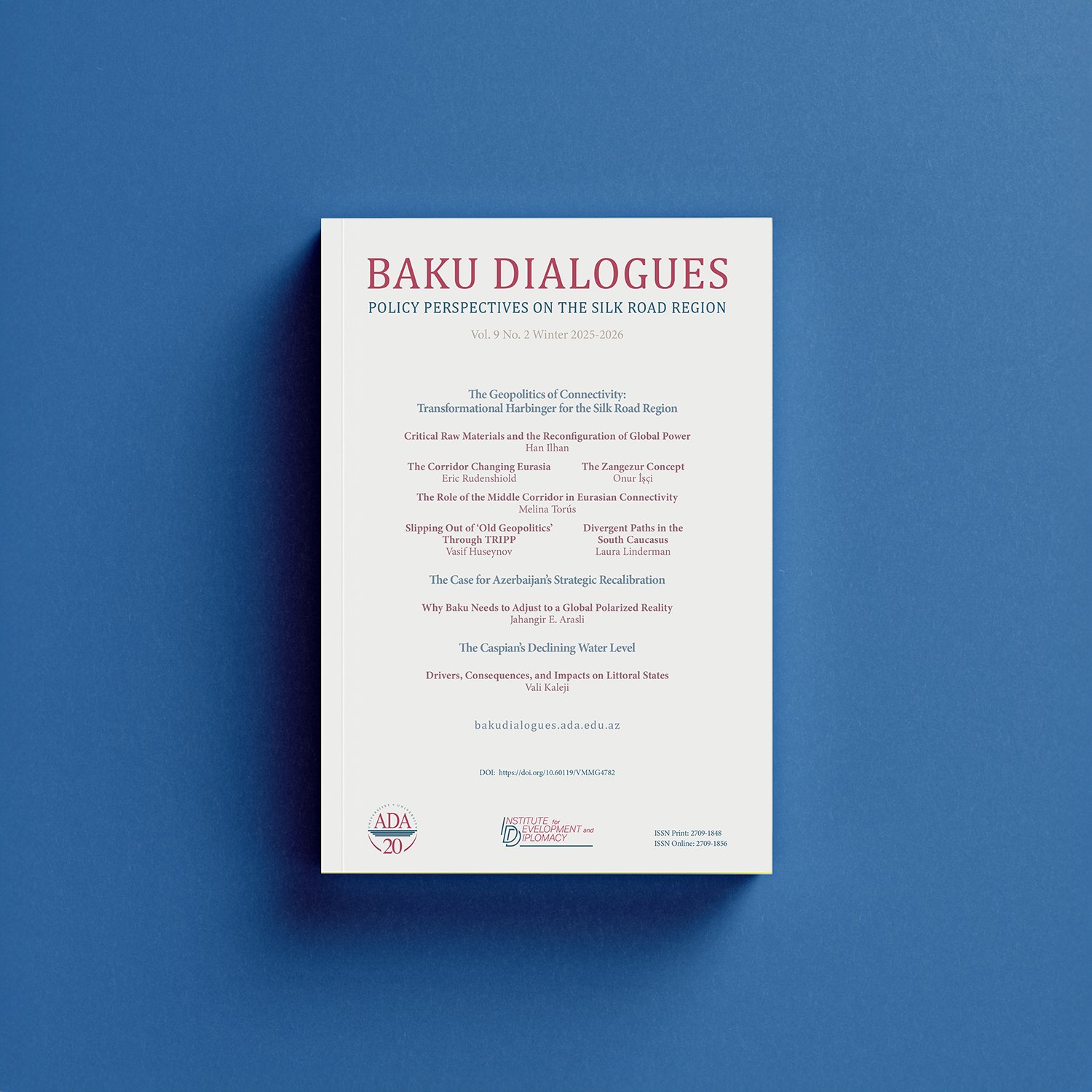
Azerbaijan’s Active Non-Alignment
How Baku is Pivoting to Greater Power
Azerbaijan’s decisive victories in the Second Karabakh War (2020) and the subsequent Anti‑Terror Operation (2023) resolved one of the most enduring conflicts of the post‑Cold War era, bringing an end to nearly three decades of Armenian occupation over almost one‑fifth of Azerbaijani territory. These two victories also enabled Baku to consolidate its position not only as a formidable military power but also as an emerging diplomatic center serving as an essential platform for regional cooperation and multilateral engagement. As Svante Cornell wrote in the Fall 2020 edition of Baku Dialogues, “Azerbaijan has embarked on a foreign policy that seeks to maintain functioning relations with all neighbors and avoid making itself dependent on any particular power for its security.”
The comprehensive nature of Azerbaijan’s triumph has opened the way for genuine dialogue with Yerevan and other regional actors, affirming Baku’s status as a rising geopolitical power. The liberation of Karabakh has not only entrenched Azerbaijan’s economic, military, and political influence in the Silk Road region but has also enabled it to project diplomatic reach beyond the Silk Road region—from facilitating rapprochement between Türkiye and Israel to expanding energy exports as far afield as Syria while becoming a vital guarantor of European energy security.
Beyond its successful integration into the wider diplomatic arena, Azerbaijan’s most remarkable achievement has been its ability to establish a new regional balance of power following the war—a pivotal turning point in contemporary geopolitics. With the Karabakh issue resolved, Baku is no longer constrained by a single‑issue foreign policy doctrine that once limited its capacity to realize its multilateral potential fully.
Azerbaijan’s most remarkable achievement has been its ability to establish a new regional balance of power following the war—a pivotal turning point in contemporary geopolitics.
Today, Azerbaijan is shaping a new, balanced foreign policy that is economically sustainable, politically diverse, and firmly independent. What once was a non‑aligned state in both practice and formality (as an official member of the NonAligned Movement) has undergone a transition—or rather, an evolution—toward a policy of “Active Non‑Alignment” (ANA). That is, it has shifted from a strategy of strategic precarity to one of strategic power‑seeking.
Azerbaijan is shaping a new, balanced foreign policy that is economically sustainable, politically diverse, and firmly independent.
To fully understand the foregoing, one must situate Azerbaijan’s foreign policy evolution within the broader history of non‑alignment. In its original self‑understanding, non‑alignment was a calibration strategy that proliferated in the developing world in response to the bloc‑making of the Cold War. These often smaller, poorer, and less powerful states— many of which were emerging from centuries of Western colonial domination—pursued three key principles: “non‑participation in military pacts with great powers,” the refusal to take sides in bloc conflicts or enter a priori alliances, and the preservation and “furtherance of national interests,” to refer to a 1977 article by Muhammad Badiul Alam in the journal World Affairs.
The pursuit of such a policy duly served Azerbaijan as a cornerstone of its hydrocarbon, logistical, and transportation connectivity in the Silk Road region—even more so after it formally joined the Non‑Aligned Movement in May 2011. Baku prioritized the preservation of peace and open relationships with all great powers to ensure the full realization of its policy without external threats. Under conditions of peace and mutual relations, Azerbaijan could worry less about external pressures and instead focus its energies on the conflict over Karabakh and the expansion of its hydrocarbon market—both vital to its national security.
Indeed, with the Armenia‑Azerbaijan conflict nearing a full resolution and its hydrocarbon and cross‑regional corridors becoming ever more important in the shadow of deepening geopolitical and geoeconomic divisions, Baku’s non‑alignment no longer has to be passive but can instead be distinctly active.
Azerbaijan, along with several other small and middle powers of the developing world, is now pursuing a strategy articulated by academics such as Carlos Ominami, Carlos Fortín, and Jorge Heine—one entails balancing ties across rival powers to extract benefits, reduce dependency, and resist coercion, all in an effort to accentuate regional power, that is, Active NonAlignment (ANA). States pursuing an ANA strategy also assert leadership in multilateral forums without being subordinated to major powers. This is evident in Latin American and East Asian states balancing between the U.S.‑China rivalry, and similarly within greater Eurasia, where states like Azerbaijan and India navigate between the United States and Russia.
Unlike Cold War‑era non‑alignment, which emphasized avoidance, Azerbaijan’s Active Non‑Alignment seeks to actively leverage competition among neighbors, regional players, and global actors to advance its national interests. Azerbaijani foreign policy is thus proactive, pragmatic, and sovereignty‑centered, with its pivot to greater power permeating three levels of analysis.
Azerbaijan’s Active Non‑Alignment seeks to actively leverage competition among neighbors, regional players, and global actors to advance its national interests.
At the neighborhood level, strategic balancing and assertive realism have enabled Azerbaijan to occupy a leadership position amid a limited Russian and Western rollback in the South Caucasus and Central Asia; at the regional level, Baku has emerged as a tacit third pillar alongside the growing alliance between moderate Arab states and Israel in the Middle East; and at the systemic level, Azerbaijan’s multivector hedging and multilateralism have allowed it to project influence and safeguard national interests in an increasingly fragmenting world order.
Each will be examined in turn, in the context of the ANA argument presented in this essay.
Neighborhood Level
At the neighborhood level, we begin with Türkiye. Ankara’s unconditional support for the liberation of Karabakh extended beyond military assistance (it only really ramped up in the runup to the 2020 war); it also reflected brotherly solidarity and moral responsibility grounded in shared history, culture, and identity. Turkish support for Azerbaijan’s territorial integrity was reinforced when Turkish F‑16 Viper fighter jets were stationed at Ganja International Airport during the war.
In the aftermath of the Second Karabakh War, relations between Azerbaijan and Türkiye entered a new phase of cooperation. What had been described as an informal “brotherly” relationship evolved into a formalized strategic alliance across military, economic, and cultural spheres. This transformation was institutionalized with the signing of the Shusha Declaration in June 2021, a landmark agreement designating Türkiye as a formal ally of Azerbaijan. By codifying the principle of “one nation, two states” within the legally binding framework of a treaty, the Declaration established a structured basis for expanded cooperation. In practice, this translates into joint defense initiatives, regularized military exercises, and collaboration in the defense industry.
The Shusha Declaration not only strengthened bilateral relations but also underscored Azerbaijan’s determination to deepen its strategic partnership with Türkiye. This marked a decisive shift from cultural kinship to a geopolitical alliance. In a region marked by uncertainty, this partnership represents a bold step toward sustainable security guarantees and long‑term cooperation.
Although Azerbaijan is entrenched within this alliance as an emerging asymmetric actor, it continues to pursue an ANA foreign policy, reinforced by reliable partnerships. Azerbaijan balances Türkiye’s regional aspirations with its own interests, evident in Baku’s calibrated diplomacy and pursuit of strategic goals beyond Turkish influence.
Evidence of this independence is reflected in Azerbaijan’s role in assisting Türkiye with managing its complicated relations with Israel. Maintaining strong ties with both, Baku leverages its position to facilitate negotiations and ease tensions. Azerbaijani President Ilham Aliyev confirmed that Azerbaijan played a pivotal role in the first reconciliation between Türkiye and Israel, which led to Israeli President Isaac Herzog’s state visit to Ankara. Azerbaijan also helped establish a “red line” mechanism in Syria, enabling direct contact between the Israeli Defense Forces and Turkishbacked forces, thus preventing escalation.
Azerbaijan’s post‑war diplomacy with Türkiye has expanded into the energy sector. In August 2025, Baku announced that it will export 1.2 bcm of natural gas annually to Syria through Türkiye via the restored Kilis‑Aleppo pipeline. Supported by Türkiye and funded by Qatar, the project symbolizes a significant shift in regional energy cooperation and reflects Ankara’s active involvement in Syria’s reconstruction. Azerbaijani Minister of Economy Mikayil Jabbarov highlighted Türkiye’s crucial support, stating that cooperation between the two states made this success possible. The pipeline not only provides energy to Syria but also creates a new corridor linking the South Caucasus to the Middle East.
Recent developments highlight Azerbaijan’s optimism regarding the trajectory of its relationship with Türkiye, building on the Shusha Declaration, which elevated Baku’s ties with Ankara to the level of a strategic and formal alliance. Azerbaijan pragmatically balances its foreign policy with Türkiye while maintaining relations with other allies and exploring new avenues of cooperation, reflecting a nuanced and multifaceted approach.
Remaining in the neighborhood, we turn next to Russia. Baku’s relationship with Moscow is dual‑edged: on one hand, as a direct border‑to‑border neighbor in the South Caucasus; on the other, as a small state within the orbit of a great power. In both respects, Azerbaijan has not only adopted a more strategic posture but has also significantly pushed back against the centuries‑old patron‑client dynamic with Russia.
In the years preceding the Second Karabakh War, Baku, as a neighbor of a larger and more militarily capable state, observed a series of military interventions and expansive operations by Moscow against ostensibly Euro‑Atlantic‑aligned states such as Georgia, Moldova, and Ukraine. Since the very beginning of its reemergence as an independent state, Azerbaijan has had to tread carefully to avoid a similar fate. Indeed, the 10 November 2020 Russian‑brokered ceasefire between Azerbaijan and Armenia, which Russia guaranteed, included a clause mandating the deployment of Russian peacekeepers across most of the former NagornoKarabakh Autonomous Oblast. By February 2022, only days prior to the onset of the current stage in the conflict over Ukraine, Baku and Moscow signed the Declaration on Allied Interaction between the Republic of Azerbaijan and the Russian Federation.
The document described Azerbaijan and Russia’s “historical traditions of friendship and good neighborliness” and pledged to raise “bilateral relations to a qualitatively new […] level of allied relations.” It committed both states to mutual security guarantees through respect for territorial sovereignty, joint defense cooperation, and consultations in times of threat, as well as to deepening economic partnership in trade, energy, transport, and finance. In the immediate aftermath, the move appeared to some outside observers to signal Azerbaijan’s full alignment with Russia. But instead, it has turned out to be an example of Baku’s ANA gameplay.
In the years that followed, Azerbaijan’s accommodation of Russia became a veritable Trojan horse for Baku’s power‑seeking, apparent from a three‑step process: first, deepen and strengthen the bilateral relationship into an allied partnership; second, build sufficient trust so that, during a period of Kremlin overextension, Azerbaijan would be entrusted with and share the burden of regional security; and third, challenge and ultimately displace Russia’s position of primacy in the South Caucasus.
Having completed the first step, the latter two steps were also successful. Russia’s invasion of Ukraine and its economic reorientation due to the effects of the Western‑led sanctions and export restrictions regime, combined with Azerbaijan’s formal alliance with Türkiye and its own Anti‑Terror Operation in Karabakh in 2023, established the context in which an early Russian peacekeeper withdrawal became feasible. This indicated to many analysts that, amid Russia’s focus on the Ukraine theater, the Kremlin had ceded its security umbrella to its rival, Türkiye, and to its ally, Azerbaijan.
The end result was that Azerbaijan has been able to distance itself from Russia in practice. After 2023, Russia no longer appeared to be a third pillar of security in the South Caucasus; as a result, Azerbaijan and Türkiye have emerged as the two primary arbiters of power in the region.
Whereas pre‑2020 Baku sought to move as little as possible to avoid provoking Russia, a postwar Baku guided by its ANA posture actively pursued, if not overtly triggered, a series of maneuvers to reduce Russia’s footprint in its neighborhood, as evidenced by its salami‑slicing tactics in Karabakh between 2020 and 2023. Still, as Uzbekistan’s former Foreign Minister Vladimir Norov has put it (in the context of Central Asia, but the statement is valid with regards to the South Caucasus as well), although “Russia is no longer the ‘big brother,’ [it remains] one of several major partners.”
The third neighborhood power is Iran. The Islamic Republic’s strategic posture toward Azerbaijan did not change after the Second Karabakh War. This is to some extent due to the fact that the losing side in that conflict— Armenia—was—and, in some ways, remains—a stalwart ally (and friendly neighbor) of Iran.
Tehran’s stance is often perceived as an adverse reaction to Azerbaijan’s sovereign ambitions, particularly regarding the establishment of the Zangezur Corridor, which has been known since August 2025 as the Trump Route for International Peace and Prosperity (TRIPP). This strategically vital route would establish a direct connection between mainland Azerbaijan and its Nakhchivan enclave, bolstering territorial integrity and development, and facilitating transport from China to Europe along the fastest and only unsanctioned land route.
Baku has long viewed Iran as a country with which it shares historical, cultural, and religious ties. A significant factor is the 35 million ethnic‑Azerbaijanis living in northern Iran. While Azerbaijan expects its neighbors to refrain from interfering in its internal affairs, some in Iran’s ruling elite, including figures like Ali Akbar Velayati and members of the religious ruling class, have fueled anti‑Azerbaijan rhetoric. From accusations of conspiracies to declaring the Zangezur Corridor Iran’s “red line,” Tehran has projected suspicion.
Although Azerbaijan’s stance toward Iran has been historically neutral, the post‑war dynamic has shifted. Having secured a victory against Armenia in Karabakh and strengthened its military with support from Türkiye and Israel, Azerbaijan now engages Iran from a position of confidence. Its neutrality and cooperation no longer stem from fear but from good faith and a desire to engage with a reformist, pro‑minority Iranian government to secure more favorable bilateral terms.
Still, Azerbaijan has demonstrated it can respond decisively if provoked. In 2023, when its embassy in Tehran was attacked, Baku suspended diplomatic relations and attributed responsibility to the Islamic Revolutionary Guard Corps (IRGC). This highlighted Azerbaijan’s readiness to defend its interests while maintaining pragmatism.
A turning point came with the July 2024 election of Masoud Pezeshkian, an ethnic‑Azerbaijani, as Iran’s president. His victory opened a more pragmatic chapter in relations, with Tehran reducing military exercises along the border. Baku welcomed this shift and invited him for a state visit, during which he attended the Seventeenth Summit of the Economic Cooperation Organization in Khankendi, the former center of Karabakh Armenian irredentism.
Nevertheless, Azerbaijan remains cautious. Hardline elements in Iran continue to fuel anti‑Azerbaijan sentiment through media and religious institutions. For Baku to fully embrace cooperation, Tehran must address this persistent hostility. Other elements in Iranian politics, rooted in post‑imperialist ambitions to project influence and dominate trade routes, perpetuate military provocations along the border. Such hawkish approaches reflect Iran’s insecurity in the evolving South Caucasus, where Azerbaijan’s assertiveness highlights its growing role as an independent regional actor. Iran’s skepticism toward the U.S.‑ brokered peace agreement further demonstrates its intolerance of Azerbaijan’s rise as a multilateral diplomatic power.
Despite Baku’s balanced foreign policy, Iran has a tendency to frame its bilateral relationship within the context of Azerbaijan’s ties with Israel. The integration of Israeli military technology into Azerbaijan’s defense industry reflects, in part, a pragmatic response to Iran’s posture. While Azerbaijan’s policy does not threaten Tehran, Iran frames Israel‑Azerbaijan ties as antagonistic to undermine Baku’s regional role. This baseless narrative highlights Tehran’s unease with Azerbaijan’s growing influence and military success. In the wake of the White House trilateral at which TRIPP was announced in August 2025, elements of the Iranian elite were again rhetorically out in force. Since then, however, statements out of Tehran have been more restrained, perhaps in part because TRIPP is a deal that enjoys the support of its Armenian ally.
The last neighboring state to be examined is Armenia. Since 2020, following the Russiabrokered ceasefire and the 2023 anti‑terror operations that effectively ended hostilities between Baku and Yerevan, Armenia’s rhetoric has gradually shifted from that of an adversary to that of a negotiating neighbor, taking significant diplomatic steps toward reconciliation and peace. A pivotal moment in the peace process emerged in October 2022 at the Prague meeting, where both states reaffirmed their mutual respect for territorial integrity and sovereignty, explicitly ruling out any potential territorial claims. Anchoring this declaration in the principle of uti possidetis juris and the Soviet‑era borders established a legal and diplomatic foundation for resolving disputes peacefully and paved the way for border delimitation. The Prague statements, delivered during Ukraine’s successful counteroffensive against Russia, marked a new chapter in history: Armenia was no longer an adversary but a neighbor with whom Azerbaijan could negotiate.
Peaceful steps towards the practical implementation of the Prague commitments were taken in April 2024 when four Azerbaijani villages controlled by Armenia were returned. Following this event, both countries entered a new stage of border demarcation and installed posts, signaling a resolution to settle matters through increasingly direct talks.
Eventually, this process led to the culmination of the Whitw House summit, where the two countries’ foreign ministers initialed—in the presence of their respective bosses and U.S. President Donald J. Trump—the text of the Agreement on the Establishment of Peace and Interstate Relations between the Republic of Armenia and the Republic of Azerbaijan whilst their bosses reaffirmed their commitment to sign the peace treaty after Armenia amends its constitution. A separate document outlined the TRIPP vision, boosting the prospects for regional connectivity and cooperation to advance the Middle Corridor.
The disbandment of the OSCE Minsk Group on 1 September 2025 represented another crucial milestone in the peace process, enabling both countries to engage in good faith and conduct dialogue without intermediaries. Since the establishment of constructive neighborly ties grounded in diplomacy and multilateral engagement following the drastic shift in Armenia’s foreign policy in the wake of the Second Karabakh War, it is now evident that Armenia no longer harbors grievances or revanchist ambitions toward Azerbaijan. Instead, Yerevan seems to have begun to regard Baku as a regional middle power—a keystone state, as Nikolas Gvosdev and others have argued—projecting influence, which compels neighboring Yerevan to position itself as a negotiating partner for Baku.
Regional Level
Next, we turn from a neighborhood‑level analysis to a regional one. Here, we shall concern ourselves first with the Arab‑Israel‑Azerbaijan triangle in the context of Baku’s ANA. Aliyev once reportedly compared Israel’s relations with Azerbaijan, which date back to 1991, to an iceberg: “nine‑tenths of it is below the surface.” Bilateral ties now resemble a mystery box: visible yet still secretive. Israel’s military and intelligence support helped Azerbaijan achieve a new type of victory, boosting its regional political influence. Despite strong ties, Azerbaijan had not opened an embassy in Israel for several reasons. Still, the Second Karabakh War and rising threats from Tehran, which conducted drills along Azerbaijan’s border, helped to change that (it did so in March 2023).
Previously, Baku engaged Israel discreetly to maintain Arab and Islamic bloc support. Resolving the conflict over Karabakh allowed Azerbaijan to publicize its longstanding ties more freely, while the Abraham Accords encouraged more visible engagement by other Muslim‑majority countries. From Baku’s perspective, establishing an embassy in Tel Aviv was also an independent decision, making it the first Shia‑majority country to open a diplomatic mission in Israel.
For Baku, Israel is not only a reliable ally providing military and technological support, but also a trusted partner in building a bridge between Azerbaijan and the United States. This represents a clear example of contemporary rapprochement with Washington, which had adopted an anti‑Azerbaijan stance during the Biden Administration thanks to Tony Blinken’s inept diplomacy and misunderstanding of the geopolitics of the Silk Road region. Trump’s return to power marked a pivotal moment for Baku.
In addition to Israel’s messaging, American Jewish community leaders also sent letters to Trump urging him to restore strong relations with Azerbaijan, a move that proved highly effective for Israel’s energy sector. AIPAC’s Chief Executive Officer, Elliot Brandt, also visited Azerbaijan. At a meeting with Aliyev, he stated that “Azerbaijan’s support will be remembered.” This historical moment was a first in AIPAC’s history to a Muslim‑majority state, which both Israel and the U.S. can call a very close friend.
Azerbaijan’s ambassador to Israel, Mukhtar Mammadov, additionally emphasized Israel’s role in helping Azerbaijan win the Second Karabakh War, saying that “Azerbaijan will never forget Israel's support during that time.” Contrary to some forecasters, Azerbaijan‑Israel relations did not falter in the aftermath of that war; rather, they flourished further and evolved into a multidimensional friendship based on mutual trust between two peoples who have more in common than most think. This resilience was once again demonstrated after the 7 October 2023 terrorist attacks, when the Azerbaijani public expressed solidarity with Israelis by laying flowers and placing toys in front of the Israeli Embassy in Baku. As a matter of fact, Azerbaijan and Israel are among the few countries that have consistently withstood international pressure. Although Baku was urged to halt oil supplies to Israel through the Baku‑Tbilisi‑Ceyhan pipeline, it instead acted as a guarantor of Israel’s energy security.
Israel also responded similarly during the Second Karabakh War, when much of the Western world adopted resolutions condemning Azerbaijan for liberating its formerly occupied territories from separatist forces. This dynamic illustrates a friendship forged in turbulent times, uniting two multicultural nations through shared resilience and mutual support. As a former Israeli ambassador to Azerbaijan, George Deek observed, more than 80 percent of Azerbaijanis support Israel and view it as a reliable partner. Azerbaijan has not allowed the fact that it neighbors Iran to hinder its relations with Israel, whether in the energy sector, investment in Israel’s Tamar gas project, or cooperation in artificial intelligence and education. The relationship stands out as both pragmatic and fruitful, reflecting the qualities Baku values and seeks in all of its alliances.
With respect to the Arab world, developments in the Middle East—e.g., the IsraelHamas War, the fall of the Assad regime have reshaped the regional order, dividing it between a U.S.‑ backed bloc and an Iran‑backed bloc. The former—primarily the Gulf monarchies, the new Syrian regime, and Jordan—derives its security from the U.S. and has cooperated in response to Iranian attacks and Israeli insecurity, serving as Tehran’s counterweight. U.S. policies under both Trump and the intervening Biden administrations have thus sought to foster cooperation between Israel and the former bloc by establishing and then expanding the Abraham Accords.
From a close distance, whether such bloc‑making ultimately succeeds or not, Baku views this as an opportunity to establish what amounts to an Arab‑IsraeliAzerbaijani triangle through which its influence in the Middle East could increase in two ways. First, by leveraging its growing relations with Israel to secure both economic and security backing in the region; second, by drawing on its decades‑long policy of non‑interference, which affords it the credibility to serve as a conciliatory and connective force in a reconfiguring region. In this sense, the Middle East has become a veritable geostrategic market for Azerbaijan—one in which it seeks to expand its reputation, transportation linkages, and security agreements.
The clearest evidence of this was the groundbreaking visit of Syria’s new transitional leadership to Baku in July 2025. President Ahmad Al‑Sharaa met his counterpart for a lengthy conversation on developing political, economic, cultural, and humanitarian cooperation with Baku. Al‑Sharaa later stated he wanted to “deepen cooperation in all fields, especially investment in the energy sector,” with further reports stating they discussed plans to export Azerbaijani gas to Syria via Türkiye “in the near future.”
Reports then stated that Israeli officials were headed to Baku to meet Syrian officials to strike a peace and normalization agreement. Other sources noted that holding the meetings in Azerbaijan, a decision supported by the U.S., was intended to send a message to Iran. This follows several Azerbaijani trade agreements with Gulf states, including a Comprehensive Economic Partnership Agreement with the UAE in July 2025, the country’s hosting of the “Eternal Brotherhood IV” special military exercises in September 2025, which included Qatari forces, and Baku’s role as an arbiter in the Turkish‑Israeli rapprochement in 2023. Taken together, these developments highlight Azerbaijan’s emerging role, rooted in its nonaligned posture: a broker of peace and mediator, as well as a regional connector and investment partner for Arab states.
Founded in 2000 as the Turkic Council, the Organization of Turkic States (OTS) has evolved from a sociocultural organization into a geopolitical bloc. Although the organization’s power centers are between Türkiye and the vast landmass of Central Asia, Azerbaijan—the connective bridge of the organization—has played an outsized role in its establishment and transformation.
Azerbaijan hosted the inaugural summit in Nakhchivan, where the Nakhchivan Agreement set out the organization’s objectives, including developing common foreign policy positions and deeper cooperation in trade and culture. Yet the OTS only began to function effectively after 2020, when Baku’s financial and diplomatic investments enabled the launch of major projects such as the Common Turkic Alphabet and the Joint Turkic Investment Fund in the post‑Karabakh era. Until then, the organization remained weak; afterward, it evolved into a budding security and economic union.
The anticipated launch of TRIPP—linking Türkiye with Azerbaijan and, by extension, the wider Turkic world—further underscored this shift. The victory in Karabakh signaled that a contiguous and integrated Turkic union was possible, weakening the arguments of OTS’s detractors, particularly Russia and Iran, who are apprehensive about a united Turkic region that could bisect key trade routes.
Notwithstanding the ethnolinguistic kinship that unites the region, Azerbaijan’s influence within the OTS has been closely tied to its national interests. First, the organization provides a multilateral avenue for Baku to access Central Asia’s vast trade and transport markets, with Azerbaijan as a central hub along the Middle Corridor (this has recently been supplemented by Azerbaijan's inclusion in the C5). Second, it offers a platform to foster a tightly knit bloc capable of replacing—or at least rivaling—Chinese, Euro‑Atlantic, and Russian ambitions to acquire or maintain spheres of influence in Central Asia by moving pieces around the “grand chessboard.” The increasing presence of the Euro‑Atlantic powers is especially significant given Azerbaijan’s policy of “equidistance” toward these outside powers, traditionally pursued through both formal and informal non‑alignment.
However, the OTS provided Baku with an official and robust safe haven—one in which Azerbaijan’s more active non‑alignment translated into building institutions of its own design, allowing the export of Baku’s regional power role to operate in tandem through the establishment of a native “fourth pillar” in Central Asia. In this sense, transforming the OTS into a security and economic association served three core strategies of Azerbaijan’s national interest: first, to push back against Russian and Chinese influence in Central Asia; second, to facilitate Türkiye’s emergence as a regional power in the region, exemplified by the enrichment of Kazakh and Uzbek militaries with Turkish weaponry; and third, to establish a bloc of alternative alignment that, while consistent with Baku’s policy of equidistance, would simultaneously secure for Azerbaijan a leadership role within a much broader regional framework.
Baku’s intentions became even clearer after the emergence of the 2023 Karabakh status quo. During the July 2024 OTS summit in newly liberated Shusha, Aliyev called for developing the organization into an “influential global entity,” declaring that the “twenty‑first century must be a century of progress for the Turkic world” in line with his fifth‑term pledge, articulated during his February 2024 inaugural address, to pivot Azerbaijan’s foreign policy toward Central Asia. This active—if not ambitious—approach to non‑alignment was further underscored by Aliyev’s candid public remarks in June 2024 at a meeting with members of the Parliamentary Assembly of Turkic States: “We don’t listen to anyone’s orders; we don’t allow anyone to come here and interfere in our work. Don’t hit me, and I won’t hit you. If you are going to hit me, then you will also get a headache.”
Indeed, the progress made has clearly not been impeded. Since the announcement of its Turkic World Vision‑2040 in 2021, the OTS has made significant strides in multisector cooperation. In trade and transport, the Middle Corridor initiative continues to grow in importance, with year‑on‑year growth being measured. In economics, member states are harmonizing customs procedures and transit tariffs to facilitate intra‑Turkic commerce. Most notably, in the security sphere—of particular concern to actors like China and Russia—the OTS has committed to combating “the threats of radicalization, violent extremism, Islamophobia, xenophobia and terrorism,” strengthening border security, and pursuing collaboration with other regional organizations such as the Visegrad Group.
Systemic Level
So far, we have explored Azerbaijan’s ANA at the neighborhood and regional levels. We now turn to an examination of the systematic level, which we characterize as multivector hedging in a fragmenting world order. We start with Azerbaijani foreign policy towards the West, particularly with the U.S. and the EU. It has evolved drastically, shifting from what could be described as a “situationship” characterized by limited engagement to a deeper, more strategic partnership.
While Azerbaijan’s national security doctrine has not been formally amended in the aftermath of the Second Karabakh War, it clearly endorses a pro‑Western trajectory aligned with integration into Euro‑Atlantic security and economic structures. Some version of this undeclared vision continues to shape Baku’s foreign policy orientation, earning Azerbaijan the label of a “pro‑West” country—whether in the modernization of its armed forces or its close alliance with NATO member state and brotherly country, Türkiye.
Since its victory in the Second Karabakh War, Azerbaijan has taken notable steps to expand its diplomatic relations with the West. Efforts have been made to improve ties with the U.S., culminating in high‑level engagements such as the White House summit hosted by Trump on 8 August 2025. This was a pivotal moment in Azerbaijan’s contemporary history, in part due to Trump’s resumption of the suspension of Section 907, a congressional embargo imposed on Azerbaijan to prevent the country from receiving direct U.S. aid, which had not been renewed by the Biden Administration.
Section 907 had long been considered the greatest success of Armenian lobbying groups such as the Armenian National Committee of America (ANCA) and the Armenian Assembly of America (AAA). These diaspora lobbying bodies were also the first to condemn the U.S. rapprochement with the region, where American economic and security interests are evident. With this revocation, a critical stumbling block has been removed from the bilateral political agenda. The suspension of Section 907 will increase U.S. government cooperation and open the door to investment in Azerbaijan, financially supporting the country’s ability to expand export operations to the West via TRIPP.
Azerbaijan has also expanded its cooperation with the EU in the energy sector. In 2022, following the invasion of Ukraine, the EU and Azerbaijan signed a Memorandum of Understanding on Strategic Partnership in the Field of Energy. European Commission President Ursula von der Leyen praised Azerbaijan’s role in diversifying European energy infrastructure and announced that the EU aimed to double its energy imports from Azerbaijan by 2027 through key routes such as the Southern Gas Corridor. This corridor, along with other energy infrastructure projects (like the Black Sea and Caspian green electricity corridors), has been crucial to the strategy, supported by Western investments. New energy deals mentioned at the White House underscore growing U.S. interest in leveraging Azerbaijan as a strategic energy partner amid broader geopolitical competition.
These positive developments in Azerbaijan’s post‑2020 Western orientation reflect a strategic yet cautious opening, strengthened by diplomatic ties, critical legislative shifts such as the repeal of Section 907, and significant energy cooperation. The country’s national aspiration is to transition to broader relations with the Transatlantic community while maintaining balanced regional relations with Russia and even China, whose footprints in the South Caucasus are becoming increasingly visible.
Azerbaijan, like other states that have successfully managed Russia as a neighbor, has grown increasingly skeptical of Russia’s ambition to maintain a robust sphere of influence in what it used to call its “near abroad,” particularly as Baku gains sufficient regional power to question Russia's posture without fear of reprisal.
Moreover, if Azerbaijan truly seeks to be actively non‑aligned, then it needs to rid itself of any neocolonial dynamics—and this includes recalibrating the terms of its ties with Russia. Thus, just as Azerbaijan managed to remove Russian hard power from its territory in Karabakh after 2023 through its salami‑slicing tactics, those same tactics are now being actively applied to diminish Russian soft power within its borders.
The downturn of bilateral relations triggered by the tragic downing of an Azerbaijan Airlines flight on 25 December 2024 in Russian airspace—caused by two Russian air defense missiles fired against three Ukrainian drones in the area that technically malfunctioned and exploded near the airplane—lasted nearly ten months. It was bookended by an initial but, judging by subsequent events, an insufficient apology by Putin in a phone call to Aliyev on 28 December 2024, and an in‑person apology during a meeting between the two in Dushanbe on 9 October 2025. During this downturn period, Azerbaijan improved its relations with the West (culminating in the White House summit). Before recalibrating the terms of its ties with Russia, Azerbaijan curtailed aspects of Russian soft power in the country, including suspending Sputnik's operations and terminating Russkiy Dom’s operations in the capital.
In sum, Baku’s actions were incremental and measured, yet also swift and severe—a strategy possible only for a state prepared for recourse and unburdened by other territorial distractions, undertaken to preserve its non‑aligned and unbeholden position within the international system.
The last country to examine in the context of Azerbaijan’s foreign policy at the systematic level is China, which has gone from being a silent player to an active partner in relatively short order.
The Azerbaijan‑China relationship in the years leading up to the Second Karabakh War fell short of its full potential. Although China has been widely regarded by analysts and scholars as a great power for a decade or more, Azerbaijan’s foreign policy remained primarily focused on navigating the West‑Russia interplay, while gaining standing in the developing world. The central connective element in the growing relationship was, of course, the Middle Corridor, which underwent significant development—most notably with the completion of the Baku‑Tbilisi‑Kars Railway in 2017. As the conflict over Karabakh approached its conclusion, thereby expanding the use of Azerbaijani territory for interregional transport, and as China’s Belt and Road Initiative sought to extend into the western part of the Silk Road region (i.e., the South Caucasus), confidence in expanding Sino‑Azerbaijani relations further solidified.
As with many burgeoning economic relationships, security soon emerged as a concern—if not an immediate interest—particularly for a power‑seeking state that perceives both the decline of the West and Russia as a rationale for engaging a rising Silk Road region partner. After years of developing relations through the Middle Corridor, which facilitated the transport of millions of tons of goods to Western markets, it was with this security concern in mind that Baku and Beijing signed a Comprehensive Strategic Partnership on 22 April 2025. The agreement sought to strengthen their respective roles in global supply chains, but in a manner that would render them increasingly important to one another, given China’s manufacturing capacity and Azerbaijan’s indispensable role in securing strategic connectivity across the only land trade route to Europe that bypasses Russia and Iran, two countries sanctioned by the West.
The Sino‑Azerbaijani Comprehensive Strategic Partnership has since begun to work in tandem with Baku’s participation in the Shanghai Cooperation Organization (SCO) as a Dialogue Partner (as of September 2025). Although Baku submitted a bid for full membership, it was ultimately rejected due to a lack of consensus in the membership. Nevertheless, this has not deterred Azerbaijan’s efforts to establish an even more security‑sensitive corridor with China through the International North‑South Transport Corridor, linking India, Iran, and Russia, alongside the Middle Corridor that connects the European continent to China. In this way, routes associated with the Belt and Road Initiative will traverse Azerbaijan from both north to south and east to west, positioning Baku as a veritable crossroads of connectivity in the Silk Road region. In a world that is becoming increasingly multipolar—more precisely, tripolar (China, Russia, U.S.—Baku is orienting itself toward the East for connectivity in logistics, trade, and security.
Routes associated with the Belt and Road Initiative will traverse Azerbaijan from both north to south and east to west, positioning Baku as a veritable crossroads of connectivity in the Silk Road region.
Assuming Leadership
The trajectory of Azerbaijan’s ANA was accelerated, if not triggered, thanks to the restoration of its sovereignty as a united country following two unprecedented military victories. Since 2020, Azerbaijan has not only secured military success but also achieved numerous diplomatic victories, positioning itself as a rising power capable of paving the way for other states. As presidential adviser Hikmat Hajiyev noted, “Azerbaijan won the war, and now Azerbaijan is winning the peace.” This is precisely where the country is headed.
The main difference between Azerbaijan’s old and new foreign policy is that Baku now negotiates as a powerful, sovereign regional leader, placing its national interests at the center of its diplomacy. This trend will continue with the opening of TRIPP, which is set to amplify Azerbaijan’s already stable position as an indispensable connectivity hub controlling a vital element of international trade. Historically, Baku was of great importance for its natural resources, including oil and gold, which managed to broker economic deals with the West while maintaining a balance with the East. Yet today, Azerbaijan is prepared to make more assertive choices that serve its national economic and political interests.
Its victory in the Second Karabakh War enabled Azerbaijan to strengthen its role as a bridge between Ankara and the Central Asian capitals, thereby contributing to the strategic coherence of the Turkic world for the first time in centuries. Baku also deepened its military relationships with Israel, Pakistan, and the Arab world, forging a unique brand of Realpolitik rooted in pragmatic calculation. Moreover, Azerbaijan has proven to be a reliable partner in times of crisis: for the EU, it is an increasingly important energy supplier; for Türkiye, a brotherly nation; for Israel, a close friend; for Pakistan, an example; and for the Arab world, a model of coexistence.
In these turbulent times, one fact in the South Caucasus remains indisputable: any reliable partnership must pass through Baku. This is evident in America’s renewed rapprochement with Azerbaijan as a gesture of appreciation and a boost in cooperation under Trump’s leadership, which is highly valued in the region. It is now certain and undeniable that Azerbaijan is no longer merely a follower of the regional order but an active player shaping regional norms, order, and events as a rising keystone state or middle power.
After this review of the depth and reach of Azerbaijan’s new ANA foreign policy doctrine, it is evident that Baku is increasingly punching above its weight compared to other states of similar size. While Azerbaijan’s geographic location and natural resources contribute to its importance, the country’s strategic endeavors—from forging intensive economic and security partnerships to building an evidently superior military since the end of the conflict over Karabakh with Armenia—make it insufficient to classify Azerbaijan as merely another “small state” in the international system.
Accordingly, some analysts have classified the country as a keystone state; others, as a middle power—or at least as one seeking to achieve middle‑power status through its strategic pivot and power‑seeking behavior. The latter classification, however, would place Azerbaijan in the company of established middle powers such as its neighbors Türkiye and Iran, as well as states like Israel and India, which, according to one definition, “cannot act alone effectively but may be able to have a systemic impact.” Indeed, as the Middle Corridor increasingly becomes a matter of international security, Baku’s decisions could prove decisive in ensuring the stability of cross‑regional trade.
Middle power scholar Carsten Holbraad suggests that such states are particularly “trusted to exercise their diplomatic influence and military power in the interest of international society, that they were capable of being less selfish than great powers and more responsible than small states.”
In Baku’s case, it is beginning to exercise its diplomacy to assume a leadership role in the Silk Road region and the Turkic world, right at a time when the major powers seem to be retrenching. However, whereas other middle powers possess their own regional polarities and alignments, Azerbaijan does not yet have the capacity to serve as a metropole to its own periphery. Moreover, it must still preserve its active, non‑aligned posture as a matter of state survival—a challenge somewhat more manageable for far larger states such as Türkiye or Iran.